
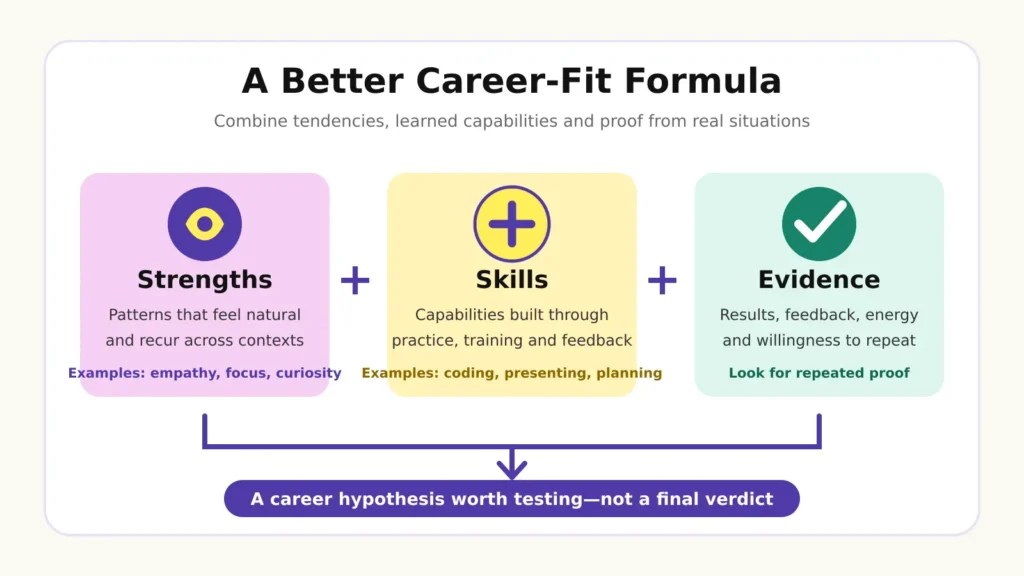
In strengths vs skills career planning, the difference is simple: a strength is a recurring way you tend to think, respond or perform well, while a skill is a capability you have learned through practice, education or experience. Neither should choose a career for you. Strengths help you generate promising directions; skills show what you can currently do; real evidence shows whether the combination works in a particular environment.
Quick answer: Do not ask whether strengths or skills matter more. List your recurring strengths, name the skills that make each strength useful, and collect examples of results, feedback, energy and willingness to repeat the task. Use the strongest combinations to create two or three career hypotheses, then test one before making a larger commitment.
Strengths vs skills in career planning: the short answer
The terms overlap in everyday speech, which is why they create confusion. A person might call communication a strength because explaining ideas feels natural, or a skill because they learned presentation structure and audience research. Both descriptions can be correct. The useful distinction is not the label itself; it is what the label helps you decide.
A strength is a pattern that appears repeatedly across situations. Examples may include noticing inconsistencies, staying calm with frustrated people, seeing how parts connect, generating alternatives or bringing structure to a vague task. A skill is an observable capability, such as analysing a spreadsheet, writing a brief, conducting an interview, using design software or coordinating a project timeline.
O*NET separates occupation information into areas such as skills, abilities, work activities and work styles. Its skills framework is useful for researching what different roles require. Your personal examples are still essential, because a database can describe a job but cannot tell you whether you want to practise its central tasks.
A practical rule: A strength without a supporting skill may remain potential. A skill without interest, energy or suitable conditions may remain useful but draining. Career fit becomes clearer when a recurring tendency, a developed capability and evidence from real tasks point in the same direction.
Use this strengths-versus-skills comparison table
Complete the table with your own evidence rather than selecting flattering words. For each possible strength or skill, ask what happened, what you actually did, what changed and whether other people noticed the contribution.
| Career-planning question | Strength | Skill | Evidence to collect |
|---|---|---|---|
| What is it? | A recurring tendency or capacity that often feels natural | A capability developed through learning and practice | Specific situations, actions, results and feedback |
| Can it change? | It can become more visible, refined or context-dependent | It can usually improve with deliberate practice | Compare performance over several months |
| What does it predict? | Tasks or conditions that may feel more intuitive or energising | Tasks you can currently perform to a useful standard | Whether you perform well and want to repeat the work |
| What can it miss? | Training requirements, opportunity and actual job conditions | Motivation, values, energy and preferred environment | Constraints, entry routes and the frustrating parts of work |
| How should you use it? | Generate career hypotheses | Assess readiness and development gaps | Run a small test before a major commitment |
What strengths can—and cannot—tell you
Strengths help you notice patterns that are easy to overlook because they feel ordinary. You may assume everyone can calm a tense group, spot the missing step in a plan or translate complex information into plain language. Repeated examples suggest that the behaviour is worth exploring further.
A strength cannot tell you that a particular occupation is automatically suitable. The same tendency may appear in very different careers. Careful listening could support counselling, user research, healthcare, teaching or customer success. You still need to compare the daily tasks, work environment, qualifications, schedule and trade-offs.
What skills can—and cannot—tell you
Skills are valuable because they are learnable and observable. You can improve them through instruction, deliberate practice, feedback and repeated use. This means a promising career should not be rejected simply because you are a beginner. A current gap may be a development plan, not proof of poor fit.
Do not confuse competence with fit. You may be skilled at a task because circumstances required years of practice, yet find it exhausting. You may also enjoy a field but dislike one necessary activity. Treat both reactions as data: redesign the role, develop the weak skill, or test a different environment before ruling out an entire career.
Build your own strength–skill–evidence map
Choose five experiences from the last twelve months. Include at least one difficult experience, because strengths often become visible when plans change. For each experience, write one line under these headings:
Then circle combinations that appear in three or more experiences. “Curiosity + interviewing + strong follow-up questions” is more useful than “good with people.” “Pattern recognition + spreadsheet analysis + error reduction” is more useful than “good at maths.” Specific combinations can be matched to real work activities.
Your map should produce hypotheses, not a permanent identity. Write, “I may fit work that combines investigation, explanation and regular contact with people.” Do not jump straight to, “I must become a psychologist.” One pattern can support several career directions, and each direction deserves a practical test.
A realistic example: one strength, several possible careers
Imagine Aisha, a recent graduate, describes herself as organised and good at communication. Those labels are too broad. She reviews a research project, a volunteer event and a part-time retail role. Across all three, she notices the same pattern: when information is scattered and people are uncertain, she asks clarifying questions, creates a simple structure and explains the next steps.
Her likely strengths are sense-making, calm communication and follow-through. Her demonstrated skills include interviewing, writing concise instructions, maintaining a task tracker and presenting updates. The evidence includes fewer missed deadlines, positive teammate feedback and customers needing fewer repeated explanations.
This combination could support project coordination, customer education, user research, operations or community programmes. It does not prove that one of those careers is right. Aisha compares their daily tasks and chooses two tests: she creates an onboarding guide for a volunteer group and interviews a project coordinator about deadlines, conflict and routine administration.
After four weeks, she reviews performance, energy and the parts she disliked. That review is more informative than choosing a title from the words “organised communicator.”
Turn the comparison into a career decision

Set your review date now. Choose a date four to six weeks away and define what evidence you will bring: one completed task, feedback from two people, notes from a practitioner conversation and a short energy log. A review date prevents endless self-analysis while keeping the decision reversible.
Common mistakes when comparing strengths and skills
For a broader starting point, read how to choose a career based on your strengths. If your evidence is still vague, use the guide to identify your natural strengths without guessing. You can also see how one capability becomes more specific in using organizational skills in career choice.
Frequently asked questions
Is communication a strength or a skill?
It can be both. Ease with reading people or explaining ideas may be a strength; active listening, presentation structure, negotiation and clear writing are skills developed through practice. Use examples to identify which part is repeated and supported by results.
Should I choose a career based on strengths or skills?
Use strengths to generate promising directions and skills to assess current readiness. Then test the combination against interests, values, work conditions, qualifications and real evidence. Neither list should make the decision alone.
Can a weakness become a skill?
Yes. A task that is currently difficult can improve through instruction and deliberate practice. Decide whether the skill is essential, whether the development cost is realistic and whether you want to use it often enough to justify the effort.
How many examples prove a strength?
There is no magic number, but three specific examples from different contexts are stronger than one memorable success. Look for repeated actions, reliable results, outside feedback and a willingness to use or improve the capability again.
Explore this topic
Turn your evidence into clearer career directions. Take the Aptitude Check free assessments, then compare the result with your strengths–skills map and one real-world experiment. Use the assessment as a starting hypothesis—not a final verdict.
Leave a Reply