Category: Skills, Strengths & Natural Abilities

Practical guides for identifying strengths, transferable skills and suitable career directions.

  • How to Choose a Career Based on Your Strengths

    How to Choose a Career Based on Your Strengths

    Direct answer: To learn how to choose a career based on your strengths, start with abilities you have demonstrated repeatedly—not flattering labels or one quiz result. Translate each strength into real work activities, then compare careers by how often those activities appear, the conditions in which you perform well, and the trade-offs you can accept. Shortlist two or three directions and test them through a small project, job shadow, interview or course before committing.

    Your strengths are useful career evidence because they show where you may learn faster, contribute more confidently or create value for other people. But a strength is not a job title. Being good at explaining does not automatically mean “teacher,” just as being analytical does not automatically mean “data scientist.” The same ability can be used across dozens of roles.

    Why choosing a career based on strengths is harder than it sounds

    Most people describe strengths too broadly: creative, organised, good with people or good at problem-solving. Those labels feel positive, yet they do not reveal what you actually do well. “Good with people” might mean listening carefully, calming conflict, persuading a hesitant customer, teaching a beginner or coordinating a team. Those activities lead to very different career options.

    Context matters too. You may communicate brilliantly one-to-one but dislike constant group interaction. You may solve complex problems well when you have quiet time, yet struggle in a rapid-response environment. A suitable career uses a strength in conditions you can sustain.

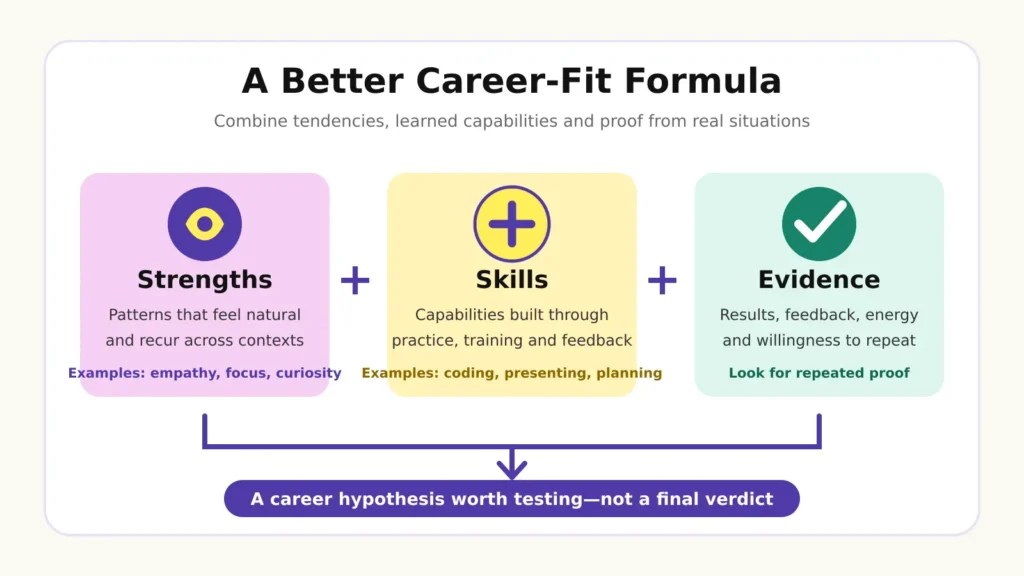
    Important distinction: A strength is something you perform effectively. An interest is something that holds your attention. A value is something you want work to provide. Strong career fit usually comes from the overlap—not from any one factor alone.

    If you are still separating ability from interest, read career interests vs skills. If every option feels vague, the broader guide on choosing a career when you have no idea can help you build an initial shortlist.

    What evidence should you collect about your strengths?

    Use behaviour you can verify. School projects, paid work, caring responsibilities, hobbies, volunteering and everyday problem-solving all count. The O*NET skills framework is helpful for naming abilities and exploring how occupations use them, but treat any framework as a research tool rather than a final verdict.

  • Repeated performance: tasks you have completed well on several occasions, not once by luck.
  • Learning speed: activities you understand or improve at faster than comparable tasks.
  • Outside evidence: specific feedback, results, requests for help or responsibilities others repeatedly trust you with.
  • Energy after use: whether using the ability leaves you engaged, neutral or consistently drained.
  • Preferred conditions: the pace, structure, autonomy, interaction and environment in which the strength appears.
  • Real constraints: training time, cost, location, income needs, health, schedule and responsibilities.
  • Better evidence: “I turned three confusing research reports into presentations classmates understood.” Weaker evidence: “People say I am smart.” Specific examples can be matched to work activities; vague praise cannot.

    Complete the strength-to-career matching workbook

    Create one row for each strength supported by at least two examples. Then translate the strength into a verb: explain, design, repair, investigate, organise, negotiate, calculate, care, persuade or build. Careers are made of activities, so verbs are more useful than personality adjectives.

    Strength evidenceWork activityConditions neededSmall test
    Explained a difficult topic clearly three timesTeach, advise, present or write guidancePreparation time and a defined audienceCreate a five-minute tutorial for a real learner
    Found errors others missedReview, test, audit or analyseQuiet focus and clear standardsQuality-check a small project using a checklist
    Kept a team project organisedPlan, coordinate and follow upVisible deadlines and shared ownershipCoordinate one short volunteer or study project
    Improved an awkward processDiagnose systems and design improvementsPermission to experiment and measure resultsMap one process and test a single change
    Use specific evidence, translate it into work activities, then test the match before making a major commitment.
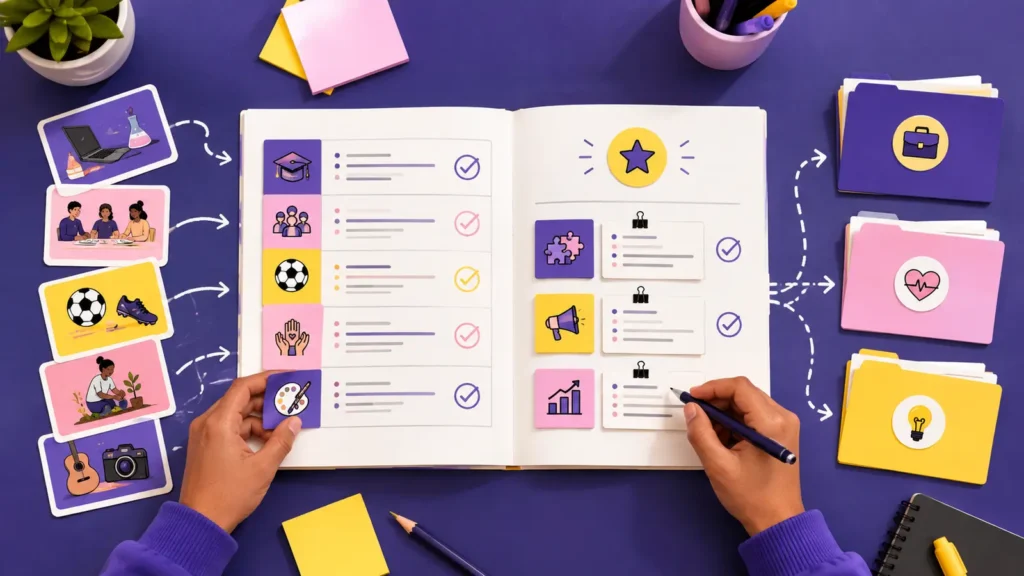
    Strength-to-career matching workbook with evidence cards and work activities
    Turn specific strength evidence into work activities, conditions and small career tests.

    Step 1: Write the evidence before naming the strength

    Describe what happened, what you did and what changed. For example: “Our group had missed two deadlines, so I divided the work, created a schedule and checked progress; we submitted on time.” Only then name the likely strengths—planning, coordination and follow-through. This order reduces wishful thinking.

    Step 2: Match strengths to work activities

    Search occupations by their daily tasks rather than their prestige or title. Planning could appear in event coordination, construction, operations, healthcare administration, logistics, film production and many other fields. Look for several roles that use the same ability in different settings.

    Step 3: Add conditions and constraints

    Ask where the strength works best. Do you need uninterrupted time, clear goals, variety, frequent feedback or collaboration? Then record non-negotiable constraints. A role that uses your strongest ability but conflicts with your health, finances or responsibilities may not be a workable fit.

    Step 4: Score the match without hiding trade-offs

    Rate each career direction from 1 to 5 for strength use, interest, work conditions, training feasibility and practical fit. Keep the five scores separate. A single total can disguise a serious problem—for example, a role may use your strengths perfectly but require training you cannot currently fund.

    Use the score as a conversation starter: A high number does not prove a career is right. A low number does not prove it is impossible. The useful part is seeing which assumption needs to be tested next.

    Apply the method to a realistic example

    Imagine Sara, a recent graduate who believes her main strength is “being organised.” Her evidence is more precise: she coordinated a university society event, recovered a group project after two missed deadlines and built a simple system that reduced duplicate work during an internship. She enjoys improving a messy process, but constant social interaction drains her.

    Sara translates the label into three activities: planning sequences, tracking dependencies and improving processes. She explores project coordination, operations analysis, supply-chain planning and production scheduling. Although event management also uses organisation, its interaction level and unpredictable hours conflict with her preferred conditions.

    Her highest-scoring options are operations analysis and project coordination. Instead of choosing immediately, Sara creates a process map for a small local business and interviews an operations analyst about a normal week. The project confirms that she enjoys diagnosing bottlenecks; the interview reveals that some analyst roles require tools she has not learned. Her next step becomes clear: take a short spreadsheet and process-mapping course, then complete a second project.

    Student reviewing career strengths and suitable work activities with a mentor
    A conversation with someone who knows the work can expose assumptions before you commit.

    Decide the next action and when to reassess

    Career choice becomes safer when commitment grows with evidence. Do not move directly from “I am good at this” to an expensive degree or resignation. Choose the smallest action that can answer your biggest remaining question.

  • Within 48 hours: write three strength stories and translate each into work activities.
  • Within one week: identify three careers that use those activities in different environments.
  • Within two weeks: speak with one person doing the work and ask about ordinary tasks, pressures and trade-offs.
  • Within one month: complete one realistic task, short course, volunteer assignment or sample project.
  • At the review date: keep, revise or remove each option based on the evidence—not on fear or fantasy.
  • Turn your strengths into career directions. Aptitude Check can help you organise patterns across abilities, interests and personality. Treat the result as a shortlist for investigation, then confirm it with real-world evidence. Take the Aptitude Check career assessment →

    Frequently asked questions

    Should I choose a career only because I am good at it?

    No. Ability matters, but so do interest, values, working conditions, constraints and willingness to keep learning. A strength you dislike using all day may be better kept as a supporting skill than made the centre of your career.

    What if I do not know my strengths?

    Start with evidence from the last year. Review projects, feedback, problems people bring to you and tasks you learned quickly. Ask two trusted people for a specific example of when you were effective. Avoid asking only, “What am I good at?” because broad answers are hard to use.

    Can I build a career around a strength I have not mastered yet?

    Yes. Career strengths include potential supported by learning speed, motivation and early evidence. You do not need expert-level skill before exploring a direction. You do need a realistic plan to practise and proof that you can tolerate the learning process.

    What if several careers use the same strengths?

    That is normal. Use work environment, values, constraints and low-risk experiments to separate them. The goal is not to find the only possible career; it is to identify a direction that is promising enough for the next step.

    Final thought: use strengths as evidence, not destiny

    Explore this topic

  • How to Identify Your Natural Strengths Without Guessing
  • How to Choose a Career If You Are Good at Many Things
  • Transferable Skills Inventory: Find Skills You Can Use in Many Careers
  • What Careers Suit People Who Like Solving Problems? Start With Problem Type
  • How to Use Creative Strengths Without Limiting Yourself to Creative Jobs
  • How to Use Organizational Skills in Career Choice
  • Strengths vs Skills in Career Planning: What Is the Difference?
  • How to Use Communication Strengths When Choosing a Career
  • Career Strengths Worksheet for Students With Little Work Experience
  • Learning how to choose a career based on your strengths is not about finding a label that predicts your future. Collect specific examples, translate them into work activities, compare the conditions in which those activities happen and test the strongest matches. A career assessment can help you notice patterns, but real work evidence should decide how far you commit.


  • Transferable Skills Inventory: Find Skills You Can Use in Many Careers

    Transferable Skills Inventory: Find Skills You Can Use in Many Careers

    A transferable skills inventory is a record of abilities you can carry from one setting to another. Instead of writing “good communicator” or “strong leader,” you connect each skill to evidence: where you used it, what you did, what changed and whether you could repeat it elsewhere. Start with experiences from school, volunteering, personal projects and paid work. Then translate the strongest patterns into the language used by careers you want to explore.

    Quick start: Choose five experiences, extract one to three skills from each, add a result or proof, and score how confidently each skill could transfer to a new role. The worksheet below makes this a 20-minute exercise.

    What counts as a transferable skill?

    Transferable skills are abilities that remain useful across different jobs and industries. Communication, coordination, problem-solving, learning, planning and decision-making are common examples. A specific tool such as a design program may be technical, but the ability to learn unfamiliar software, interpret feedback and deliver work to a deadline is more portable.

    The important word is transferable, not universal. A skill only transfers when the new role uses a similar action at a suitable level. Organising a student event can support an entry-level project-coordination claim; it does not automatically prove that you can manage a complex corporate programme. Accurate language makes your inventory more credible.

    For a structured skill vocabulary, explore O*NET’s transferable skills categories. Use the definitions to name what you actually did, rather than selecting every positive-sounding skill.

    Why a normal skills list is not enough

    People often rate themselves from memory, and memory favours recent or dramatic events. Students may ignore course projects because they were unpaid. Career changers may describe a decade of work only by job titles. Volunteers may overlook planning, persuasion or resource management because no employer formally evaluated it.

    An evidence-based inventory fixes this by starting with events, not adjectives. You first recall a concrete accomplishment or responsibility. You then identify the action you performed, the result and the conditions. Only after that do you name the skill. This order reduces guesswork and gives you material you can later use in a résumé, application or interview.

    Evidence rule: “I am organised” is an opinion. “I created a shared schedule for six volunteers and the event started on time” is evidence of planning and coordination.

    Collecting evidence of transferable skills from school, volunteering, projects and work
    Collect evidence from several settings before deciding that a skill is truly transferable.

    Build your transferable skills inventory in five steps

    1. Collect experiences from four sources

    Write down at least one example from school, volunteering, projects and work. “Work” can include a part-time job, internship, family business or caregiving responsibility. Choose situations where you completed something, solved a problem, helped someone, improved a process or learned a difficult task.

    2. Describe the action with a precise verb

    Replace broad labels with actions. Did you analyse, explain, persuade, design, coordinate, troubleshoot, prioritise, teach, negotiate, research or adapt? A precise verb reveals the real skill and makes comparison with job descriptions easier.

    3. Add proof of the result

    Proof does not have to be a sales number. It might be a finished project, an improved grade, fewer errors, positive feedback, a deadline met, a person trained or a problem prevented. If no outcome was measured, describe what changed and who benefited.

    4. Rate independence and repeatability

    Ask how much guidance you needed and whether you have demonstrated the skill more than once. Use a simple confidence score: 1 = tried once with close help, 2 = used independently once, 3 = used independently in several settings. This prevents one successful moment from becoming an exaggerated strength claim.

    5. Test portability against a target role

    Open three realistic job or course descriptions. Highlight repeated actions, not just titles. Match them to your evidence. A strong match uses a similar action and level of responsibility. A partial match becomes a development goal rather than something to hide.

    Transferable skills inventory template

    Copy this table into a document or spreadsheet. Complete five to ten rows. Keep each evidence statement short enough to scan, but specific enough that another person could understand what you did.

    ExperienceTask or actionTransferable skillEvidence or resultConfidence (1–3)
    School or studyWhat did you do?Name the portable abilityWhat changed or was completed?
    VolunteeringWhat did you do?Name the portable abilityWhat changed or was completed?
    Personal projectWhat did you do?Name the portable abilityWhat changed or was completed?
    Paid or unpaid workWhat did you do?Name the portable abilityWhat changed or was completed?
    Other responsibilityWhat did you do?Name the portable abilityWhat changed or was completed?

    After completing the table, circle skills that appear in two or more settings. Repetition is a strong clue that the ability is genuinely portable. Next, star skills you want to keep using. Being capable of something does not mean you want it to dominate your future work.

    A realistic example: from student experience to career evidence

    Imagine Amina, a university student with retail experience and no formal office role. She helped coordinate a society event, trained a new shop colleague and built a personal budget tracker. At first, she wrote “teamwork, leadership and Excel.” The inventory produced stronger evidence.

    ExperienceAction and resultSkill evidencePossible use
    Society eventScheduled five volunteers and resolved two shift gapsCoordination; prioritisationOperations, events, project support
    Retail jobExplained the checkout process to a new colleague who then worked independentlyTeaching; verbal communicationTraining, customer success, team support
    Budget trackerOrganised monthly spending and corrected formula errorsInformation organisation; quality checkingAdministration, finance support, data operations

    The table does not tell Amina that one career is her destiny. It gives her testable directions. She could compare operations assistant, customer-support and junior finance-administration roles, then look at real tasks in each. The same evidence can be rewritten for a résumé: “Coordinated schedules for five volunteers and resolved last-minute coverage gaps to keep a student event on time.”

    One transferable skill applied across healthcare, digital, education and operations careers
    A portable skill can create several career directions; compare the tasks and conditions in each.

    Turn your inventory into career options

    Group your strongest evidence into three families: people skills such as listening, teaching and coordinating; thinking skills such as analysis, judgement and problem-solving; and execution skills such as planning, quality checking and time management. Then search for occupations that use combinations of those families.

    Use your inventory with our guide on choosing a career based on your strengths. If naming strengths still feels difficult, first work through how to identify your natural strengths. When your list produces too many possibilities, apply the filters in how to narrow down career options.

    Do not choose a career from the inventory alone. Use it to create a shortlist, then test the day-to-day tasks, entry requirements, work environment and opportunities that matter in your location.

    Common mistakes to avoid

  • Listing personality traits as skills. “Friendly” may matter, but active listening or conflict resolution is easier to evidence and compare.
  • Including every skill you have ever used. Prioritise repeated, relevant skills supported by outcomes.
  • Confusing enjoyment with competence. Record both separately; a skill can be strong but draining.
  • Copying keywords without proof. Employers and course selectors can ask for examples.
  • Treating a confidence score as permanent. Skills grow through practice and feedback.
  • Decide your next action and review date

    Choose three skills with strong evidence and one skill you want to develop. For each strong skill, find two roles that use it. For the development skill, design a small 30-day test: volunteer for a task, complete a short project, practise with feedback or shadow someone doing the work.

    Set a review date four weeks from now. Add new evidence, revise confidence scores and remove claims that no longer feel accurate. A useful transferable skills inventory is a living record, not a one-time personality verdict.

    Frequently asked questions

    What are the most common transferable skills?

    Common categories include communication, teamwork, coordination, problem-solving, critical thinking, learning, planning, time management and decision-making. The best skill for your inventory is not the most popular one; it is the one you can support with clear evidence.

    Can students have transferable skills without job experience?

    Yes. Course projects, clubs, sport, volunteering, caregiving and personal projects can demonstrate portable abilities. Describe the action, outcome, level of independence and repeated use instead of focusing only on whether the experience was paid.

    How many skills should I include?

    Start with five to ten well-supported skills. A focused inventory is easier to use than a list of thirty vague claims. Add more only when they contribute a different action, evidence source or target-role match.

    Use your evidence to explore a better fit

    Explore this topic

  • What Careers Suit People Who Like Solving Problems? Start With Problem Type
  • How to Choose a Career If You Are Good at Many Things
  • Your inventory shows what you can carry forward, but a career choice also depends on interests, work values, personality, constraints and the tasks you want to perform regularly. Use Aptitude Check to organise those patterns into career directions, then validate the strongest options with research and small real-world tests.

  • How to Identify Your Natural Strengths Without Guessing

    How to Identify Your Natural Strengths Without Guessing

    If you want to know how to identify your natural strengths, stop relying on labels and look for repeated evidence. Notice the tasks you perform well across different situations, the things you learn faster than expected, the work that gives you usable energy, and the results other people repeatedly value. One success can be luck; a pattern across school, work, volunteering and personal projects is far more useful.

    Quick answer: Look for four signals—repeated performance, fast learning, sustainable energy and specific outside feedback. Treat a possible strength as credible when it appears in at least three situations and is supported by more than one signal.

    What natural strengths actually mean

    A natural strength is a capacity you can use effectively and develop further. It is not necessarily effortless. Strong communicators still prepare, analytical thinkers still make mistakes, and organised people can feel overwhelmed. The difference is that certain kinds of work tend to produce stronger results or faster growth for you than comparable activities.

    Separate strengths, skills and interests. A strength is an underlying pattern, such as explaining complex ideas clearly. A skill is a learned application, such as presenting or writing reports. An interest is what attracts your attention. You may be skilled at a task you dislike, or interested in something you have not practised enough to judge.

    Why identifying your strengths is difficult

    Your strongest abilities may feel ordinary because you experience them from the inside. You might assume everyone can calm a tense group, spot an inconsistency, remember details or turn a vague idea into a workable plan. General praise such as “you are smart” or “you are creative” is also too vague to guide a career decision.

    Context can hide a strength. A student who dislikes formal presentations may still be excellent at one-to-one explanation. Someone who struggles with routine administration may be highly organised when coordinating a live event. Instead of asking, “What am I naturally good at?” ask, “Under what conditions do I repeatedly create a useful result?”

    How to identify your natural strengths: four evidence signals

    1. Repeated performance

    Review the last two or three years and list situations that ended well because of something you did. Include assignments, team projects, part-time work, family responsibilities, sports, volunteering and hobbies. Focus on your contribution: Did you clarify the goal, notice a risk, persuade people, create the design, repair the process or keep everyone moving?

    2. Learning speed

    Look for tasks where your early improvement was noticeable. Fast learning does not mean instant mastery; it means you understood the structure quickly, needed fewer repetitions, or transferred what you learned to a new situation. This can reveal pattern recognition, spatial reasoning, active listening or practical problem-solving.

    3. Energy after the task

    Do not confuse a strength with constant enjoyment. Useful work can be tiring. Ask whether the activity leaves you with meaningful satisfaction and whether you want to improve it. A task that produces good results but reliably drains you may be a skill to use selectively, not the centre of your career.

    4. Specific outside feedback

    Ask three people who have seen you work: “When have you seen me at my best?” and “What do you trust me to handle?” Request examples. “You turn confusing instructions into clear steps” is stronger evidence than a flattering adjective.

    Evidence rule: Trust patterns more than praise. Repeated results plus specific feedback are stronger than one compliment, one high grade or one quiz result.

    Create a natural-strength evidence log

    For seven days, record moments when you solve a problem, learn quickly, receive useful feedback or become absorbed in a task. Keep entries concrete. The goal is not to prove that you are talented; it is to discover patterns you can test.

    Natural strength evidence log for tracking repeated performance
    Use a natural-strength evidence log to find patterns across different situations.
    SituationWhat I didEvidencePossible strength
    Group assignmentTurned ideas into a sequenceTeam used the plan; deadline metStructuring and coordination
    Helped a classmateExplained a difficult concept simplyThey understood and asked me againExplanation and listening
    Volunteer eventNoticed a queue problem and adjusted rolesWait time fell; organiser praised the fixObservation and problem-solving

    At the end of the week, circle repeated verbs: explained, compared, designed, persuaded, repaired, organised, supported, analysed. Rewrite vague labels as observable strengths. “Creative” might become “generates several workable approaches.” “Good with people” might become “helps people feel heard and reach agreement.”

    A realistic example

    Sara, a university student, believes she has no special strengths. Her log shows that she summarised research for a group project, created a revision plan for friends and reorganised volunteer shifts when someone cancelled. The situations differ, but the pattern is consistent: she converts scattered information into clear, practical structure.

    Sara should not jump straight to one job title. She can form a hypothesis—structured problem-solving may be a natural strength—and test it through a small project, an informational interview or a work sample. Possible environments include project coordination, operations, research support, learning design and client onboarding, but she still needs to investigate the daily tasks.

    Outside feedback revealing communication and organisation strengths
    Specific feedback can reveal strengths you may have taken for granted.

    Turn strengths into career evidence

    Translate each strength into tasks and conditions. If your strength is explanation, ask whether you prefer teaching individuals, writing instructions, presenting to groups or helping customers. If it is analysis, clarify whether you enjoy numbers, language, systems, behaviour or physical processes. The same strength can support many careers.

  • Write one strength as an observable action beginning with “I can…”
  • Attach two or three examples and the result of each.
  • Identify the conditions where it works best: alone or with people, planned or fast-moving, abstract or practical.
  • Use O*NET OnLine to compare work activities, abilities and skills across occupations.
  • Run a small test through a short project, shadowing, volunteering, a course module or a realistic task sample.
  • Use the evidence alongside broader career factors. Read our guide on how to choose a career based on your strengths, then compare your patterns with interests, values, work environment, training time and practical constraints.

    Your seven-day next step: Today, list five situations where your contribution mattered. Tomorrow, ask two people for specific examples. This week, complete the evidence log. On day seven, name your two strongest patterns and choose one real-world test. Reassess after the test.

    Common mistakes to avoid

  • Using only personality labels. A label can suggest questions, but behaviour and results provide stronger evidence.
  • Counting only paid work. School, family, hobbies and volunteering can reveal the same capacity.
  • Mistaking familiarity for strength. Repetition can make a task easy without making it a good fit.
  • Choosing a career from one strength. Sustainable fit also depends on interests, values, environment and constraints.
  • Waiting for certainty. Strengths become clearer through action, feedback and comparison.
  • Frequently asked questions

    Can a quiz identify my natural strengths?

    A good assessment can reveal patterns worth exploring, but it should not deliver a final career verdict. Use results as hypotheses and compare them with examples, feedback and real-world tests.

    What if I am not naturally good at anything?

    Most people are looking for dramatic talents and overlooking useful patterns. Start with ordinary contributions: what people ask you to help with, what you improve quickly, and what results you repeat. Strengths may be combinations rather than one exceptional ability.

    Can natural strengths change?

    Your tendencies may remain fairly consistent, but practice, opportunity and context affect how they appear. Reassess after new courses, responsibilities, projects or work environments.

    Related guidance: Next, learn how to choose a career based on your strengths or build a broader transferable skills inventory.

    Explore this topic

  • How to Choose a Career If You Are Good at Many Things
  • Career Strengths Worksheet for Students With Little Work Experience
  • Use evidence, not a label: Build a reliable, revisable picture from repeated performance, learning speed, energy and feedback. Use Aptitude Check to explore possible strength patterns, then verify them through real experiences before making a major study or career decision.

  • How to Choose a Career If You Are Good at Many Things

    How to Choose a Career If You Are Good at Many Things

    If you are good at many things, do not ask which ability is your single ‘true’ talent. Choose a career by comparing your strongest abilities across four factors: the energy they give you, the evidence that you perform them well, the demand for them and how often you want to use them. Then test the best-looking direction in real work before making a long commitment. This approach helps you turn a wide range of strengths into a focused decision without abandoning the abilities that make you versatile.

    Quick rule: Your best career fit is rarely the job that uses every strength equally. It is usually the direction that gives your most important strengths a useful role while keeping the work sustainable and valuable.

    Why being good at many things makes career choice harder

    Multiple strengths create more plausible options. A person who can write, analyse data, explain ideas and organise projects may fit marketing, research, consulting, product management, teaching or operations. Because several choices look reasonable, the decision can feel less clear—not more.

    The trap is treating ability as the only criterion. You can be good at an activity and still dislike doing it every day. You can also enjoy a strength that has weak evidence or limited demand in the market you want to enter. Career choice improves when you compare the whole pattern.

    How to choose a career if you are good at many things

    Start with a short list of four to six abilities supported by real examples. Avoid vague labels such as ‘smart’ or ‘creative.’ Use observable activities: explaining difficult ideas, finding patterns in data, designing visual concepts, calming upset people or coordinating deadlines. If you need help creating the list, begin with our guide to identifying natural strengths or a transferable skills inventory.

  • Energy: After using this ability for an hour, do you feel engaged, neutral or drained?
  • Evidence: What results, feedback, grades, projects or repeated successes prove the ability?
  • Demand: Do real roles value this ability, and can you show it in a portfolio, application or interview?
  • Desired use: How much of your working week would you genuinely like to spend using it?
  • Visual multi-strength matrix for energy evidence demand and desired use
    Compare each strength by energy, evidence, demand and desired use.

    Build a multi-strength prioritisation matrix

    Give each ability a score from 1 to 5 for the four factors. Add the scores, but do not treat the total as an automatic verdict. The matrix is a conversation starter that exposes trade-offs and tells you what needs testing.

    AbilityEnergyEvidenceDemandDesired useTotal
    Example ability1–51–51–51–5/20
    Your ability 1
    Your ability 2
    Your ability 3

    Look for the pattern: A high-energy strength with strong evidence but low current demand may need a different market. A high-demand strength that drains you may work as a supporting skill, not the centre of your career.

    A realistic example

    Imagine Maya is strong at writing, data analysis and visual design. Writing scores 16/20, analysis scores 18/20 and design scores 14/20. She enjoys all three, but her evidence and local job demand are strongest for analysis. Instead of searching for a job that divides her day perfectly between the three, she explores product insights and marketing analytics roles. Analysis becomes the core; writing helps her communicate findings; design helps her make clear dashboards.

    The important insight is not that analysis ‘wins.’ Maya has formed a testable career hypothesis: I may prefer analytical work when I can explain the result and present it visually. That hypothesis is much more useful than a broad label such as ‘I am good at many things.’

    Professional testing communication analysis and design strengths through projects
    Small work experiments provide stronger evidence than assumptions alone.

    Test the leading option before committing

    Scores are useful, but experience is stronger evidence. Run one small experiment for your leading direction: complete a realistic project, shadow someone, volunteer, take a short course with assignments or interview two people doing the work. Use the O*NET skills database to compare your assumptions with skills linked to real occupations.

  • Choose one career direction to test for two weeks.
  • Create one task that resembles the actual work, not only reading about it.
  • Record energy, performance, feedback and whether you want to repeat the task.
  • Update the matrix and compare the result with your next-best option.
  • Use secondary strengths as an advantage

    You do not need to discard strengths that are not central to the role. Secondary strengths can become your differentiator. A software developer who explains clearly may grow into technical leadership. A teacher with strong design ability may build better learning materials. An operations specialist with empathy may improve customer processes. Choose a stable centre, then let the other strengths improve how you perform it.

    Mistakes to avoid

  • Choosing only by praise: other people may value a skill you do not want to use constantly.
  • Demanding a perfect match: no role will use every ability in exactly the proportion you prefer.
  • Keeping every option open: permanent exploration prevents you from collecting deeper evidence.
  • Letting a quiz decide: an assessment can reveal patterns, but your experiences and experiments must confirm them.
  • Your 30-day next step: Complete the matrix today, research three roles this week and run one work sample within 14 days. Set a review date 30 days from now. At that review, choose whether to deepen the leading path, test the second option or collect one missing piece of evidence.

    Frequently asked questions

    Should I choose the career linked to my strongest skill?

    Not automatically. Your strongest skill also needs acceptable energy, market demand and a level of use you would enjoy. A slightly weaker ability may be a better career centre if it scores well across all four factors.

    What if two options score almost the same?

    Test both with small, comparable projects. The purpose is not to predict the perfect future; it is to gather better evidence at a reasonable cost.

    Choose a direction, not a permanent identity

    Knowing how to choose a career if you are good at many things is really about prioritising evidence. Pick the strongest current direction, use your other abilities as supporting advantages and reassess after real experience. For a broader method, read how to choose a career based on your strengths. You can also use Aptitude Check to organise your strengths into clearer career-fit patterns—without treating one result as a final verdict.

  • What Careers Suit People Who Like Solving Problems? Start With Problem Type

    What Careers Suit People Who Like Solving Problems? Start With Problem Type

    If you are asking what careers suit people who like solving problems, start by identifying the type of problem you enjoy. A person who loves debugging software may dislike mediating conflict, while someone who is excellent at helping people may feel bored optimizing a spreadsheet. Suitable careers can include engineering, healthcare, design, education, operations, research and many others—but the job title matters less than the problems that fill an ordinary working day.

    Quick answer: Do not choose from a generic “best careers for problem solvers” list. Separate technical, human, creative and operational problems, collect examples of when each type energized you, then test two or three matching career directions through small real tasks.

    Why “I like solving problems” is not specific enough

    Problem solving is not a narrow talent. It appears in almost every occupation, from repairing equipment to teaching a difficult concept or redesigning a delivery process. O*NET defines complex problem solving as identifying a difficult problem, reviewing relevant information, evaluating options and implementing a solution. Its occupation data also shows that the skill appears across hundreds of roles, so it cannot choose a career for you on its own.

    The useful clue is your preferred combination of problem, method and environment. Ask whether you want a clear answer or an open-ended one. Notice whether you prefer working with people, data, ideas or physical systems. Then consider pace: some problems unfold over months; others demand a decision in minutes. These details turn a broad strength into evidence you can use.

    What careers suit people who like solving problems? Four useful types

    Use these categories as a map, not as boxes. Many careers combine two or more types. A nurse may solve human, technical and operational problems in one shift. A product manager may move between user needs, creative options and delivery constraints. Your goal is to find the mix that feels rewarding most often.

    Problem typeWhat feels satisfyingCareer directions to explorePossible mismatch
    TechnicalDiagnosing why a system, machine or piece of code failsSoftware development, engineering, cybersecurity, laboratory technology, skilled tradesYou enjoy the answer but dislike prolonged technical detail
    HumanUnderstanding needs, reducing conflict or helping someone progressCounselling, teaching, healthcare, customer research, human resources, community workYou like helping but constant emotional demand drains you
    CreativeTurning an unclear brief into an original idea, design or storyProduct design, marketing, architecture, writing, user experience, media productionYou enjoy ideas but dislike revision, constraints or feedback
    OperationalMaking a process faster, safer, clearer or more reliableOperations, logistics, project coordination, quality assurance, event production, supply chainYou like organizing your own work but not coordinating dependencies
    Four-part career map showing technical, human, creative and operational problems
    Different careers reward different kinds of problem solving.

    Build your problem-type career map

    Create four columns labelled technical, human, creative and operational. Under each, record evidence from school, work, volunteering, hobbies and everyday life. Do not write what you think you should enjoy. Record specific situations in which you stayed engaged long enough to understand the problem and improve the result.

  • Situation: What was wrong, unclear or inefficient?
  • Your action: Did you diagnose, explain, design, coordinate, repair or persuade?
  • Energy: Did the work make you curious, focused, tense or depleted?
  • Result: What improved, and what feedback did you receive?
  • Repeatability: Would you willingly solve a similar problem again next week?
  • Circle the two columns with the strongest repeated evidence. Next, search for occupations in which those problem types are central, then inspect real tasks rather than attractive titles. The O*NET complex problem-solving occupation list is a useful starting point. Compare it with job adverts and practitioner interviews in your location because training routes, pay and day-to-day duties vary.

    Worked example: from “good at problems” to three career hypotheses

    Imagine Sam says, “I am good at solving problems,” but has no preferred career. Sam reviews recent evidence. Troubleshooting a family laptop was mildly interesting, but explaining the fix was more satisfying. During a student event, Sam enjoyed calming confused attendees and reorganizing the registration process. Creating posters was enjoyable only until repeated design revisions began.

    The pattern is stronger for human and operational problems than for purely technical or creative ones. Instead of assuming “problem solver” means engineer, Sam creates three hypotheses: customer success, healthcare administration and project coordination. Each option uses explanation, prioritization and process improvement, but in a different environment.

    A career hypothesis is not a commitment. It is a direction worth testing. A quiz or worksheet can help you generate hypotheses, but no single score should overrule lived evidence, practical constraints or what the work actually requires.

    Test career directions before choosing

    Sam now designs one small experiment for each option. For customer success, Sam helps a community group document common member questions. For healthcare administration, Sam interviews an administrator about workflow, privacy and patient-service pressures. For project coordination, Sam plans a small event with deadlines, dependencies and a short review afterward.

    After every experiment, Sam rates curiosity, energy after the task, desire to improve and tolerance for the frustrating parts. The final question matters most: “Would I want to get better at this problem even when it becomes repetitive or difficult?” Enjoying a polished success is easy; career fit becomes clearer when you experience the process.

    Young adult testing technical, people-focused and operational career tasks
    Small experiments reveal which problems you actually enjoy solving.

    Common mistakes to avoid

  • Choosing a prestigious title without checking its routine tasks.
  • Treating one memorable success as proof of a lasting strength.
  • Ignoring the work environment, emotional load, training cost or schedule.
  • Assuming technical problems are more valuable than human, creative or operational ones.
  • Rejecting a promising direction because you do not yet have the required skill.
  • A strength can be developed, and a preference can change with experience. If you are strong in several areas, use the process in how to choose a career when you are good at many things. For a wider view of capability, start with choosing a career based on your strengths. When two tested options remain close, compare them with a career decision matrix.

    Choose a next step and set a review date

    Choose the career hypothesis with the best combination of repeated evidence, practical feasibility and willingness to keep learning. Then take one reversible next step: a short course, job shadow, portfolio task, volunteer project or practitioner conversation. Set a review date four to six weeks away. Reassess sooner if the real work contradicts your assumptions; reassess later if you need enough exposure to move beyond first impressions.

    So, what careers suit people who like solving problems? The strongest answer is not a fixed list. It is the set of careers whose recurring problems, working methods and environments match the evidence you collect about yourself. Aptitude Check can help you identify strengths and generate suitable directions, but your next experiment is what turns a possibility into useful evidence.


    Frequently asked questions

    Is problem solving a skill or a personality trait?

    It is primarily a transferable skill, supported by habits such as curiosity, persistence and comfort with uncertainty. Your preferred problem type is a separate question from your current skill level.

    Do problem solvers have to work in technology?

    No. Teachers, nurses, designers, counsellors, operations professionals and many other roles solve complex problems. Technology is only one setting.

    What if I enjoy more than one type of problem?

    Explore this topic

  • How to Use Creative Strengths Without Limiting Yourself to Creative Jobs
  • Transferable Skills Inventory: Find Skills You Can Use in Many Careers
  • That is normal. Look for hybrid roles, then rank the mix you want most often. Test whether the secondary problem type adds variety or creates unwanted pressure.

  • How to Use Creative Strengths Without Limiting Yourself to Creative Jobs

    How to Use Creative Strengths Without Limiting Yourself to Creative Jobs

    Quick answer: To learn how to use creative strengths in career choice, identify the kind of creativity you repeatedly use—generating ideas, improving designs, explaining concepts or experimenting with solutions—then look for roles where those actions are part of ordinary work. Test the fit with a small project before treating any job title as the answer.

    Creative strength is not reserved for artists, writers or designers. It can appear when a nurse improves a patient handover, an engineer prototypes a safer component, a teacher invents a clearer explanation or a marketer tests a new campaign angle. The career clue is not simply that you are “creative.” It is how you create and which problems you enjoy improving.

    This guide shows how to use creative strengths in career choice by turning a broad label into a practical creative-strength opportunity grid. You will map evidence from your past, compare several industries and run one low-risk experiment. The result should be a shortlist worth investigating—not a permanent verdict from one quiz or preference.

    Why creative strengths are easy to misread

    People often confuse creativity with a visible product such as a painting, video or logo. That definition hides less obvious forms: finding an unusual route through a technical problem, connecting ideas from different fields, simplifying a process or adapting a service to a person’s needs. It also encourages an unhelpful choice between a “creative career” and a “practical career,” even though many jobs require both.

    Job titles create another problem. Two people called product managers may use creativity differently: one may shape new concepts while another mainly coordinates delivery. O*NET describes thinking creatively as developing, designing or creating new applications, ideas, relationships, systems or products. That broad work activity appears across occupations, so daily tasks matter more than the label.

    Use evidence, not identity: “I am a creative person” is a useful starting belief. “I generated three alternatives, built a rough version, used feedback and improved the result” is career evidence you can compare.

    What kind of creative strength do you actually use?

    Look back at school, hobbies, volunteering and paid work. Choose moments when you produced something useful and wanted to keep improving it. Then separate the action from the subject. Editing a club video might show visual storytelling, but it could also reveal planning, audience awareness or patient iteration.

  • Ideation: You generate several possible approaches instead of stopping at the first answer.
  • Design: You shape information, experiences or objects so they work better for a particular user.
  • Experimentation: You build rough versions, test assumptions and learn from feedback.
  • Creative explanation: You make a complicated idea easier to understand through examples, stories or visuals.
  • Improvement: You notice friction in a system and imagine a more useful process.
  • For each strength, write one example that another person could observe. Include the problem, what you changed and the result. Repeated examples are stronger than compliments such as “you are imaginative.” If evidence is thin, treat the strength as a hypothesis to test.

    Build a creative-strength opportunity grid

    The grid prevents you from jumping from “I like creativity” to a narrow list of artistic jobs. Place your strongest creative action down the left side. Across the top, compare different problem areas and work settings. Fill each cell with a real task, not a glamorous title.

    Creative-strength opportunity grid

    Create five columns: industry or problem, creative task, people affected, evidence I already have, and small test. Add at least six rows from different fields. Circle the rows where the task attracts you, the environment fits you and the entry route is realistic.

    Creative strengths used across technology healthcare education and community work
    Creative thinking can appear in technical, caring, educational, commercial and community work.

    Map the same strength across several industries

    A strength becomes more useful when you can see where it travels. The examples below are possibilities, not recommendations. Research the actual occupation and employer because the balance of creative work can vary widely.

    Creative actionWhere it may appearExample task
    Generate optionsBusiness, policy, engineeringDevelop alternatives for a product, service or system
    Design for peopleTechnology, healthcare, educationImprove an interface, patient journey or lesson
    Tell a clear storyMarketing, journalism, researchTurn complex evidence into an understandable message
    Experiment and iterateProduct, science, operationsBuild a prototype, test it and revise the approach
    Reimagine a processAdministration, logistics, community workReduce delays, confusion or unnecessary steps

    Notice that none of these rows promises a perfect career. They produce search terms. Use O*NET occupation reports and the U.S. Department of Labor’s Skills Matcher to investigate duties, related skills and training. Then read real job descriptions and speak with people doing the work.

    How to use creative strengths in career choice: run a mini project

    Research helps, but a short task gives stronger evidence. Choose two or three rows from your grid and design a two- to five-hour project for each. Keep the subject similar where possible so you are comparing the creative action, not your familiarity with the topic.

  • Design test: Redesign a confusing sign-up flow, information sheet or classroom activity for a specific user.
  • Idea test: Generate ten ways to solve a local problem, group them and defend the best two against clear constraints.
  • Story test: Turn a dense report into a one-page explanation for a non-expert audience.
  • Experiment test: Build a simple prototype, show it to three people and revise it from their feedback.
  • Student testing a creative strength through a low risk mini project
    A small realistic project can reveal whether you enjoy the process of creative work, not only the final result.

    Worked example:

    Sam enjoys turning messy information into clear visuals but assumes the only option is graphic design. The grid reveals related tasks in data communication, learning design, public-health campaigns and product onboarding. Sam creates the same one-page explainer for two audiences, interviews a content designer and tests an introductory data-visualisation lesson. The experience shows that audience research and simplification are more energising than decoration alone.

    Evaluate the evidence before deciding

    After each mini project, score the experience from 1 to 5. Record task enjoyment, willingness to practise, response to feedback, environment fit and practical feasibility. Add a confidence note: direct experience deserves more weight than an assumption based on a video or job title.

  • Did I enjoy generating alternatives, or only the finished result?
  • Did feedback make me curious to improve, or defensive and drained?
  • Would I repeat this task weekly, not just once?
  • Do I want to learn the less glamorous skills the work requires?
  • Does the training, cost, schedule and income path fit my current constraints?
  • This is how to use creative strengths in career choice without overcommitting: choose the direction with the strongest combined evidence and define one reversible next step, such as a conversation, short course, volunteer task, portfolio project or shadowing opportunity. Set a review date. A career decision becomes safer when it is a sequence of evidence-building commitments rather than one irreversible leap.

    Common mistakes to avoid

  • Searching only for “creative jobs”: search by tasks such as prototyping, explaining, improving and experimenting.
  • Assuming talent equals fit: you may be good at an activity but dislike its deadlines, feedback culture or environment.
  • Ignoring execution: ideas matter, but most roles also require research, collaboration, detail and follow-through.
  • Letting one result decide: use assessments to organize possibilities, then verify them with real tasks.
  • Choosing prestige over repetition: ask whether you want the ordinary weekly work, not only the impressive outcome.
  • Frequently asked questions

    Do creative strengths require artistic talent?

    No. Artistic work is one expression of creativity. Creative thinking can also involve designing systems, generating alternatives, communicating ideas and improving services. Your examples should show which form you use.

    Which careers use creative thinking?

    Creative thinking appears in many fields, including technology, engineering, healthcare, education, marketing, research and operations. The amount and type vary by role and employer, so compare tasks rather than relying on broad industry labels.

    Can a career assessment identify my creative strengths?

    It can help you notice patterns and generate directions to explore. It cannot observe every skill, constraint or workplace. Combine the result with examples from your behavior, occupation research and small real-world tests.


    Turn your creative patterns into career directions

    Aptitude Check can help you organise your interests, strengths and work preferences into career possibilities worth testing. Use the opportunity grid above to compare those possibilities with real evidence.

    Take the Aptitude Check free assessments

    Continue exploring your career strengths

    Start with how to choose a career based on your strengths. Then build clearer evidence with how to identify your natural strengths and the transferable skills inventory.

    Explore this topic

  • How to Use Organizational Skills in Career Choice
  • What Careers Suit People Who Like Solving Problems? Start With Problem Type
  • For external research, explore O*NET work activities and the Department of Labor’s CareerOneStop Skills Matcher. Use these sources to expand and verify options, not to treat one score as a final career verdict.

  • How to Use Organizational Skills in Career Choice

    How to Use Organizational Skills in Career Choice

    If you are learning how to use organizational skills in career choice, start by looking beyond job titles. Notice the work you naturally do well: planning steps, arranging information, coordinating people, tracking deadlines, preventing mistakes and bringing unfinished tasks to completion. Then match those strengths to real work contexts. Organisational ability can support many careers, but the best fit depends on what you like organising, how much structure you want and whether the work gives you energy.

    Quick answer: Collect examples of times you planned, coordinated or controlled details; identify which part you enjoyed; compare those tasks with the daily work of several occupations; then test one promising direction through a small project, conversation or short placement.

    Why organisational skills are useful career evidence

    “I am organised” is too broad to guide a career decision. One person may enjoy creating a schedule, another may be excellent at keeping records accurate, while someone else can coordinate a busy group without losing track of priorities. These are related strengths, but they point toward different environments.

    Organisational skills matter because work is not only about ideas or technical knowledge. Most roles also require people to decide what comes first, use limited time well, communicate dependencies and check that important details have not been missed. The stronger evidence is not a self-description; it is a repeated pattern in school, volunteering, home responsibilities, projects or paid work.

    Important: A career quiz can reveal patterns worth exploring, but one result should never become a final verdict. Use it to improve your questions, then confirm the fit with real tasks and real-world evidence.

    How to use organizational skills in career choice

    Break the label into specific behaviours. Look for situations in which other people relied on you or your system made a result more predictable. The following five forms of organisation are especially useful to separate:

  • Planning: turning a goal into stages, estimating time and deciding the order of work.
  • Prioritisation: distinguishing what is urgent, important, optional or dependent on another task.
  • Coordination: keeping people, resources and deadlines aligned while information changes.
  • Detail control: checking records, requirements, quality standards or small errors before delivery.
  • Follow-through: monitoring progress, updating the plan and closing loops instead of only starting well.
  • Write one example beside each item. A useful example names the situation, your action and the result. “I organised our class event” is weak evidence. “I created a task list, confirmed suppliers, reminded volunteers and adjusted the schedule when one delivery was late” shows the strength in action.

    Young adults using coordination and prioritisation as organisational career strengths
    Separate planning, prioritisation and coordination so you can match the right strength to the right work context.

    Complete the organisation-skill task matcher

    The task matcher helps you connect demonstrated strengths to work rather than choosing a career because its name sounds impressive. Use five short steps.

    1. Collect three pieces of evidence

    Choose examples from different settings: a group assignment, a personal responsibility, a club, a part-time job or a volunteer task. For each example, record what was disorganised at the beginning, what you changed and what improved. Repeated evidence is more useful than one unusually successful day.

    2. Identify the organising task you enjoyed

    Separate competence from preference. You may be capable of maintaining detailed records but find it draining, or you may enjoy coordinating people even when it becomes unpredictable. Mark each task as energising, neutral or tiring. A suitable career should use strengths in a way you can sustain.

    3. Name the work context

    Ask what you were organising: information, people, events, physical resources, money, schedules, customer requests or quality standards. This distinction opens better career options. Someone who likes arranging information may enjoy research operations or records work, while someone who likes moving parts and deadlines may prefer project coordination, logistics or events.

    4. Decide how much structure you want

    Some people organise best inside clear rules; others enjoy creating order in changing situations. Highly regulated settings can reward accuracy and consistency. Fast-moving settings can reward rapid prioritisation and communication. Neither is automatically better. The question is where your strengths remain reliable without causing constant stress.

    5. Match tasks to occupations, then verify

    Search occupation profiles for daily activities, work context and entry requirements. O*NET OnLine can help you compare abilities across occupations, but do not stop at a database description. Read current vacancies and speak with someone doing the work to learn how the role operates in practice.

    Your one-line match: “I organise [people, information, resources or standards] by [planning, coordinating, tracking or checking], and I prefer a [stable or changing] work environment.” Use this sentence to guide career research.

    Career areas where organisational strengths can matter

    Organisational ability is portable. It can support many career families, so treat the examples below as research directions rather than automatic matches:

  • Project and operations coordination: sequencing work, tracking progress and resolving dependencies.
  • Logistics and supply chain: coordinating inventory, movement, schedules and suppliers.
  • Administration and office operations: maintaining reliable systems, records and communication.
  • Events and hospitality: aligning people, timing, spaces, vendors and unexpected changes.
  • Healthcare administration: handling schedules, records and procedures where accuracy matters.
  • Quality assurance and compliance: checking requirements, documenting evidence and reducing errors.
  • Research, laboratory or data operations: organising information, samples, protocols and timelines.
  • Finance and business support: tracking transactions, documents, deadlines and recurring processes.
  • Detail control and follow-through shown as organizational skills for career choice
    Reliable detail control and follow-through can be as valuable as planning the first steps.

    Do not choose from the list alone. The same title can involve very different daily tasks in different organisations. Compare job descriptions, constraints, training routes and work environments before deciding.

    A realistic example: from “organised student” to career clues

    Imagine Sara is known for keeping group assignments on track. At first, she assumes this means she should become an administrator. When she studies the evidence, she notices something more specific: she enjoys turning a vague project into stages, assigning owners and adjusting deadlines when plans change. She dislikes repetitive filing but enjoys coordinating people and solving timing problems.

    That pattern gives Sara several directions to test, including project coordination, event operations, production planning and logistics. She reads job descriptions, compares entry routes and asks two professionals what a normal week looks like. Instead of making a final choice from a personality label, she runs a small event project and volunteers to coordinate a student campaign. The experience gives her stronger evidence about both ability and enjoyment.

    Test the fit before making a large commitment

    A low-risk test can show whether you like the real task, not only the idea of the career. Choose one experiment you can complete within two to four weeks:

  • Plan a small event, campaign or group project with real deadlines and people depending on you.
  • Build a simple tracking system for a club, volunteer team or family project and review whether it improves the result.
  • Ask a professional to show you the tools, recurring tasks and difficult trade-offs in their role.
  • Take a short project-based course in operations, project coordination, quality assurance or another relevant field.
  • After the test, review four questions: Did I perform well? Did I enjoy the central task? What conditions helped or drained me? What evidence should I collect next? This keeps the decision provisional and practical.

    Use strengths as one part of a complete career decision

    Organisational strengths are valuable, but they should be combined with interests, values, work conditions and realistic entry routes. Start with the broader guide on how to choose a career based on your strengths. You can also compare how different abilities shape direction in using creative strengths in career choice and explore careers for people who like solving problems.

    Frequently asked questions

    Are organisational skills natural or learned?

    Both. Some people notice patterns, deadlines or missing details more quickly, but planning systems, prioritisation, communication and quality checks can all improve through practice. Career planning should consider your current evidence and your willingness to develop the skill further.

    What if I am organised only in certain situations?

    That is useful information. Identify what changes between the situations: interest, clarity, pressure, autonomy, stakes or the type of task. Context-specific strength is more informative than forcing a general label.

    Do organisational skills mean I should work in an office?

    No. These strengths also matter in healthcare, construction, logistics, hospitality, education, laboratories, creative production and community work. Focus on the activities and environment rather than the building or stereotype.

    What is the next step after identifying this strength?

    Choose two or three career directions, verify their daily tasks and complete one low-cost experiment. Set a date to review what you learned instead of trying to make a permanent decision immediately.

    Explore this topic

  • Strengths vs Skills in Career Planning: What Is the Difference?
  • Turn your strengths into clearer career directions. Take the Aptitude Check free assessments, then use the results as a starting point for research and real-world testing.

  • How to Use Communication Strengths When Choosing a Career

    How to Use Communication Strengths When Choosing a Career

    If you want to know how to use communication strengths in career choice, begin by separating “good communication” into specific behaviours. Writing clearly, explaining ideas, persuading, listening and facilitating are different strengths, and each becomes valuable in different work settings. Collect examples of when your communication improved an outcome, notice which mode gives you energy, then compare careers by their daily communication demands. Use this evidence to create two or three career hypotheses and test them before making a major commitment.

    Quick answer: Build a five-part communication profile covering writing, explaining, persuading, listening and facilitating. For each mode, record evidence, energy, preferred audience and working conditions. Then research roles where your strongest two modes are used regularly. A communication strength should guide the next career test—not decide your future by itself.

    Why “I am a good communicator” is not specific enough

    Communication is often treated as one broad soft skill. In practice, a person can write excellent reports but dislike live presentations. Someone who is persuasive in a one-to-one conversation may feel drained by constant networking. A careful listener may be excellent at uncovering customer needs without enjoying a high-volume customer-service environment.

    The setting changes the meaning of the strength. Explaining a science concept to a student is different from presenting quarterly results to executives. Facilitating a calm workshop is different from mediating a conflict. Before you connect communication ability to a career, identify what you communicate, to whom, through which channel and under what pressure.

    Avoid the job-title shortcut. Communication appears in healthcare, engineering, education, research, technology, operations, sales, public service and creative work. Do not limit yourself to careers with “communications” in the title. Compare the actual tasks and context.

    Separate your five communication strengths

    The official O*NET skills framework distinguishes abilities such as writing, speaking and active listening, while its broader skill profiles show that occupations use different combinations. The five-part profile below translates those distinctions into practical career evidence.

    1. Writing: making ideas clear without being present

    Writing strength is not only good grammar. It includes choosing the right detail, organizing information and adapting the message to the reader. Useful evidence might include a guide that reduced questions, a report that helped a group decide or feedback that your instructions were easy to follow. Careers to investigate include technical writing, policy work, content design, research and documentation.

    2. Explaining: helping someone understand or act

    Explaining means translating complexity into a structure another person can use. Look for moments when a customer understood a process after your demonstration or a team moved forward because you clarified the issue. This strength appears in teaching, learning design, healthcare, product support and leadership. Check whether you prefer one-to-one explanations, groups or visual demonstrations.

    3. Persuading: influencing a decision ethically

    Persuasion combines audience awareness, credible reasoning and a clear request. Evidence might include winning support for an event or presenting a proposal that received funding. It is useful in sales, fundraising, advocacy, recruitment and management. Distinguish thoughtful influence from aggressive pressure; the style you can sustain matters.

    4. Listening: discovering what is not obvious

    Strong listening is active work. It involves asking useful questions, noticing uncertainty and checking your understanding. Evidence could come from resolving a misunderstanding or identifying a hidden need. Listening supports counselling, user research, healthcare, human resources, customer success and technical work that requires careful requirements gathering.

    5. Facilitating: helping a group make progress

    Facilitation means guiding a conversation without controlling every idea. You keep the purpose visible, invite quieter voices and move the group toward a decision. Evidence may come from leading a study group, coordinating volunteers or running a workshop. Project management, community work, operations and training often use this strength.

    Group comparing writing, explaining, persuading, listening and facilitating strengths
    Separate communication into specific modes before connecting it to a career.

    Collect evidence before choosing a direction

    A strength is more convincing when it appears across different situations. Review school, volunteering, hobbies, paid work, personal projects and community activities. For every communication example, write down the audience, purpose, difficulty, action and result. “People say I communicate well” is weak evidence. “I redesigned the volunteer instructions and new members completed setup with fewer questions” is specific and testable.

  • Outcome: What became clearer, faster, calmer or more persuasive because of your communication?
  • Repeatability: Has this happened in at least three different situations?
  • Energy: Did the activity leave you satisfied, neutral or depleted?
  • Feedback: What did other people specifically say or ask you to do again?
  • Conditions: Did you work best with preparation, live interaction, a small group, a written channel or time pressure?
  • Growth: Are you willing to practise the weaker parts required by the role?
  • Evidence rule: Keep a strength on your profile when you can describe a real behaviour and outcome. Keep it as a hypothesis when it is based only on preference, praise or an assessment result. Both are useful, but they should not carry equal weight.

    Complete your communication-strength profile

    Copy this table into a document or notebook. Complete one row for each communication mode. The goal is not to give every strength a high score. The goal is to see which combinations are supported by evidence and which conditions make them sustainable.

    Communication modeYour evidenceBest conditionsCareer test
    WritingWhat did you make clearer?Long-form, concise, technical or creative?Write a guide, brief or article.
    ExplainingWho understood or acted?One-to-one, group, visual or verbal?Teach a short lesson or demo.
    PersuadingWhich decision changed?Consultative, public or negotiation?Pitch a real proposal ethically.
    ListeningWhat hidden need emerged?Interview, support or advisory?Run two structured interviews.
    FacilitatingHow did a group progress?Planning, conflict or workshop?Guide a 30-minute discussion.

    Add two final columns if useful: an energy score from 1–5 and an evidence score from 1–5. A high ability score with low energy may indicate something you can do but do not want as a major part of your day. A high energy score with weak evidence suggests a promising area to practise and test.

    Apply the profile to a realistic example

    Imagine Aisha, a recent graduate who describes herself as a people person. Her evidence shows something more precise. She wrote clear onboarding notes for a student society, helped new members explain their concerns and guided meetings when the group became stuck. She received strong feedback for listening, explaining and facilitating. She disliked competitive debates and felt drained when she had to make repeated cold pitches.

    Aisha does not conclude that every people-focused career will suit her. She creates three hypotheses: customer education, user research and learning coordination. All three use her strongest modes, but the audience, pace and purpose differ. She reads occupation descriptions, studies real job adverts and asks professionals how much of the week is spent interviewing, presenting, documenting and coordinating.

    Next, she runs low-risk tests. She interviews two users for a community project, creates a ten-minute tutorial and facilitates one volunteer planning session. After each activity, she records the outcome, energy, frustration and desire to improve. The tests give her better evidence than simply choosing “marketing” or “HR” because those jobs sound social.

    Career explorer testing communication fit through an informational interview
    Ask professionals how communication is used during an ordinary workday—not only whether they enjoy the career.

    Match the strength to the work context

  • How often is this communication mode used during a normal week?
  • Is the audience one person, a team, the public or senior decision-makers?
  • How much preparation is available before communicating?
  • Is the purpose to inform, teach, investigate, support, negotiate or sell?
  • How much conflict, emotional intensity or rejection is typical?
  • Does the role also fit your interests, values, constraints and preferred work environment?
  • Better career question: Replace “Which jobs are good for communicators?” with “Which roles repeatedly use my strongest communication modes, with an audience and level of pressure I can sustain?” That question produces much better options.

    Choose two or three careers to test

    Use your top two communication modes as search criteria, not as a final answer. If writing and explaining are strongest, explore technical documentation, learning design, content design or policy communication. If listening and facilitating stand out, investigate user research, advising, community development, human resources or project coordination. Then compare the non-communication tasks that fill the rest of each role.

    Start with the broader guide on how to choose a career based on your strengths. If several abilities compete for attention, use the process for choosing a career when you are good at many things. You can also compare the kinds of challenges you enjoy through careers for people who like solving problems.

    Run a 30-day communication career test

  • Week 1 — Profile: Gather five to ten examples and score evidence, energy and preferred conditions.
  • Week 2 — Research: Compare three roles using O*NET descriptions, real job adverts and ordinary daily tasks.
  • Week 3 — Conversations: Interview two professionals. Ask what they wrote, explained, listened to or facilitated yesterday.
  • Week 4 — Practice: Complete one representative project and request specific feedback on the outcome.
  • Review: Keep, revise or reject each career hypothesis. Choose the next experiment and a date to reassess.

  • Frequently asked questions

    What careers are good for people with strong communication skills?

    Many careers use communication, including education, healthcare, user research, technical writing, customer success, consulting, sales, public service, project management and human resources. The better match depends on whether your evidence is strongest in writing, explaining, persuading, listening or facilitating—and on the audience and pressure you prefer.

    Can an introvert have strong communication skills?

    Yes. Communication quality is not the same as sociability. An introvert may be an excellent writer, prepared presenter, careful interviewer or calm facilitator. Evaluate observable behaviours and outcomes instead of using personality labels as limits.

    Should communication skills be the main factor in career choice?

    No single strength should decide a career. Combine communication evidence with interests, values, preferred environment, practical constraints, training requirements and the rest of the daily work. Use the strength to narrow and test options.

    How can I prove communication skills without work experience?

    Use examples from school projects, volunteering, clubs, community activities, online collaborations and personal projects. Create fresh evidence by writing a guide, teaching a short lesson, interviewing users or facilitating a meeting. Record the outcome and request specific feedback.

    Explore this topic

  • Career Strengths Worksheet for Students With Little Work Experience
  • Strengths vs Skills in Career Planning: What Is the Difference?
  • Explore your strengths with Aptitude Check. Use the Study & Career Assessment to identify possible strength, interest and work-style patterns. Treat the report as a source of career hypotheses, then verify those ideas with your communication profile and real-world tests. Start the Aptitude Check assessment →

  • Strengths vs Skills in Career Planning: What Is the Difference?

    Strengths vs Skills in Career Planning: What Is the Difference?

    In strengths vs skills career planning, the difference is simple: a strength is a recurring way you tend to think, respond or perform well, while a skill is a capability you have learned through practice, education or experience. Neither should choose a career for you. Strengths help you generate promising directions; skills show what you can currently do; real evidence shows whether the combination works in a particular environment.

    Quick answer: Do not ask whether strengths or skills matter more. List your recurring strengths, name the skills that make each strength useful, and collect examples of results, feedback, energy and willingness to repeat the task. Use the strongest combinations to create two or three career hypotheses, then test one before making a larger commitment.

    Strengths vs skills in career planning: the short answer

    The terms overlap in everyday speech, which is why they create confusion. A person might call communication a strength because explaining ideas feels natural, or a skill because they learned presentation structure and audience research. Both descriptions can be correct. The useful distinction is not the label itself; it is what the label helps you decide.

    A strength is a pattern that appears repeatedly across situations. Examples may include noticing inconsistencies, staying calm with frustrated people, seeing how parts connect, generating alternatives or bringing structure to a vague task. A skill is an observable capability, such as analysing a spreadsheet, writing a brief, conducting an interview, using design software or coordinating a project timeline.

    O*NET separates occupation information into areas such as skills, abilities, work activities and work styles. Its skills framework is useful for researching what different roles require. Your personal examples are still essential, because a database can describe a job but cannot tell you whether you want to practise its central tasks.

    A practical rule: A strength without a supporting skill may remain potential. A skill without interest, energy or suitable conditions may remain useful but draining. Career fit becomes clearer when a recurring tendency, a developed capability and evidence from real tasks point in the same direction.

    Use this strengths-versus-skills comparison table

    Complete the table with your own evidence rather than selecting flattering words. For each possible strength or skill, ask what happened, what you actually did, what changed and whether other people noticed the contribution.

    Career-planning questionStrengthSkillEvidence to collect
    What is it?A recurring tendency or capacity that often feels naturalA capability developed through learning and practiceSpecific situations, actions, results and feedback
    Can it change?It can become more visible, refined or context-dependentIt can usually improve with deliberate practiceCompare performance over several months
    What does it predict?Tasks or conditions that may feel more intuitive or energisingTasks you can currently perform to a useful standardWhether you perform well and want to repeat the work
    What can it miss?Training requirements, opportunity and actual job conditionsMotivation, values, energy and preferred environmentConstraints, entry routes and the frustrating parts of work
    How should you use it?Generate career hypothesesAssess readiness and development gapsRun a small test before a major commitment
    Use strengths and skills together, then verify both with repeated real-world evidence.
    Strengths vs skills career planning framework combining evidence
    Combine strengths, skills and repeated evidence to create a career hypothesis worth testing.

    What strengths can—and cannot—tell you

    Strengths help you notice patterns that are easy to overlook because they feel ordinary. You may assume everyone can calm a tense group, spot the missing step in a plan or translate complex information into plain language. Repeated examples suggest that the behaviour is worth exploring further.

  • Look for the pattern in at least three different settings, such as study, work, volunteering, hobbies or family responsibilities.
  • Separate the action from the outcome. “The event succeeded” is vague; “I reorganised the schedule when a supplier was late” shows what you contributed.
  • Track energy after the task. Performing well once does not prove that you want the activity to dominate your working week.
  • Ask for specific feedback: “When have you seen me make a difficult task easier?” produces better evidence than “What are my strengths?”
  • A strength cannot tell you that a particular occupation is automatically suitable. The same tendency may appear in very different careers. Careful listening could support counselling, user research, healthcare, teaching or customer success. You still need to compare the daily tasks, work environment, qualifications, schedule and trade-offs.

    What skills can—and cannot—tell you

    Skills are valuable because they are learnable and observable. You can improve them through instruction, deliberate practice, feedback and repeated use. This means a promising career should not be rejected simply because you are a beginner. A current gap may be a development plan, not proof of poor fit.

  • Technical skills include capabilities tied to tools, methods or specialist knowledge.
  • Transferable skills—such as analysis, communication, planning and problem solving—can be useful across industries.
  • Context changes the skill. Presenting to five classmates is different from briefing senior leaders or teaching a nervous client.
  • Proficiency needs proof: a completed project, measurable result, portfolio sample, assessment, reference or reliable feedback.
  • Do not confuse competence with fit. You may be skilled at a task because circumstances required years of practice, yet find it exhausting. You may also enjoy a field but dislike one necessary activity. Treat both reactions as data: redesign the role, develop the weak skill, or test a different environment before ruling out an entire career.

    Build your own strength–skill–evidence map

    Choose five experiences from the last twelve months. Include at least one difficult experience, because strengths often become visible when plans change. For each experience, write one line under these headings:

  • Situation: What needed to be achieved or improved?
  • Strength: Which recurring tendency helped you respond?
  • Skill: What learned capability did you use?
  • Evidence: What result, output or feedback shows the contribution?
  • Energy: Did you want to repeat or improve the task after it ended?
  • Context: Which people, pace, structure and level of autonomy helped you perform?
  • Then circle combinations that appear in three or more experiences. “Curiosity + interviewing + strong follow-up questions” is more useful than “good with people.” “Pattern recognition + spreadsheet analysis + error reduction” is more useful than “good at maths.” Specific combinations can be matched to real work activities.

    Your map should produce hypotheses, not a permanent identity. Write, “I may fit work that combines investigation, explanation and regular contact with people.” Do not jump straight to, “I must become a psychologist.” One pattern can support several career directions, and each direction deserves a practical test.

    A realistic example: one strength, several possible careers

    Imagine Aisha, a recent graduate, describes herself as organised and good at communication. Those labels are too broad. She reviews a research project, a volunteer event and a part-time retail role. Across all three, she notices the same pattern: when information is scattered and people are uncertain, she asks clarifying questions, creates a simple structure and explains the next steps.

    Her likely strengths are sense-making, calm communication and follow-through. Her demonstrated skills include interviewing, writing concise instructions, maintaining a task tracker and presenting updates. The evidence includes fewer missed deadlines, positive teammate feedback and customers needing fewer repeated explanations.

    This combination could support project coordination, customer education, user research, operations or community programmes. It does not prove that one of those careers is right. Aisha compares their daily tasks and chooses two tests: she creates an onboarding guide for a volunteer group and interviews a project coordinator about deadlines, conflict and routine administration.

    After four weeks, she reviews performance, energy and the parts she disliked. That review is more informative than choosing a title from the words “organised communicator.”

    Turn the comparison into a career decision

    Young adults testing strengths and skills through a collaborative project
    Real tasks, feedback and repeated practice turn strengths and skills into useful career evidence.
  • Name two or three career hypotheses. Match the repeated strength–skill combinations to occupations where those activities are central.
  • Check the real work. Read current job descriptions and occupation profiles, then ask a practitioner what they did last week.
  • Identify one development gap. Choose a skill that can be practised in a small project rather than enrolling in a major programme immediately.
  • Run a representative test. Complete a short project, volunteer task, job shadow, portfolio exercise or structured conversation.
  • Review on a specific date. Compare results, feedback, energy, constraints and desire to improve before deciding the next step.
  • Set your review date now. Choose a date four to six weeks away and define what evidence you will bring: one completed task, feedback from two people, notes from a practitioner conversation and a short energy log. A review date prevents endless self-analysis while keeping the decision reversible.

    Common mistakes when comparing strengths and skills

  • Treating “natural” as fixed and assuming strengths never develop.
  • Choosing only from skills you already possess and ignoring learnable gaps.
  • Using positive feedback without checking whether the task is sustainable.
  • Selecting a career from a broad label instead of its recurring daily activities.
  • Letting one quiz score overrule experience, constraints or current occupation research.
  • Collecting evidence forever without choosing a test and review date.
  • For a broader starting point, read how to choose a career based on your strengths. If your evidence is still vague, use the guide to identify your natural strengths without guessing. You can also see how one capability becomes more specific in using organizational skills in career choice.


    Frequently asked questions

    Is communication a strength or a skill?

    It can be both. Ease with reading people or explaining ideas may be a strength; active listening, presentation structure, negotiation and clear writing are skills developed through practice. Use examples to identify which part is repeated and supported by results.

    Should I choose a career based on strengths or skills?

    Use strengths to generate promising directions and skills to assess current readiness. Then test the combination against interests, values, work conditions, qualifications and real evidence. Neither list should make the decision alone.

    Can a weakness become a skill?

    Yes. A task that is currently difficult can improve through instruction and deliberate practice. Decide whether the skill is essential, whether the development cost is realistic and whether you want to use it often enough to justify the effort.

    How many examples prove a strength?

    There is no magic number, but three specific examples from different contexts are stronger than one memorable success. Look for repeated actions, reliable results, outside feedback and a willingness to use or improve the capability again.

    Explore this topic

  • How to Use Communication Strengths When Choosing a Career
  • Turn your evidence into clearer career directions. Take the Aptitude Check free assessments, then compare the result with your strengths–skills map and one real-world experiment. Use the assessment as a starting hypothesis—not a final verdict.

  • Career Strengths Worksheet for Students With Little Work Experience

    Career Strengths Worksheet for Students With Little Work Experience

    Direct answer: A career strengths worksheet for students should turn ordinary experiences into proof. List moments from coursework, group projects, clubs, sport, volunteering, hobbies and responsibilities at home. For each one, record the task, the action you took, the result and any specific feedback. Strengths that appear across several situations are more credible than labels chosen because they sound impressive.

    You do not need years of paid work to understand what you may be good at. Student life already contains deadlines, difficult conversations, research, creative decisions, teamwork and unexpected problems. The challenge is learning to describe that evidence clearly enough to guide career exploration.

    Why identifying strengths without work experience feels difficult

    Students often compare themselves with professionals and conclude that they have no strengths because they have not held a formal job. That confuses experience with evidence. Employment can provide evidence, but it is not the only place where abilities appear. Completing a demanding assignment, tutoring a classmate, coordinating a society event or caring for a family member can reveal real patterns of communication, planning, judgement and persistence.

    Another problem is vague language. Words such as creative, smart or good with people are too broad for career planning. A useful strength statement describes behaviour: simplifying technical information, spotting inconsistencies, generating several solutions, calming disagreement or keeping a team on schedule.

    Use evidence before labels: Write what you did and what changed first. Name the possible strength afterwards. This order reduces guesswork and gives you examples you can later use in applications and interviews.

    What evidence should students collect?

    Start with activities you can verify. The O*NET essential-skills framework offers useful language for abilities used across occupations, while the NACE career-readiness competencies show how communication, critical thinking, teamwork, leadership, professionalism and technology can be demonstrated in different ways. Use these frameworks to name patterns, not to produce a final verdict about your future.

  • Coursework: research, presentations, laboratory work, essays, design briefs and difficult topics you learned.
  • Group assignments: planning, resolving disagreements, checking quality, explaining ideas and meeting deadlines.
  • Extracurricular activities: clubs, sport, competitions, student government, events and creative projects.
  • Volunteering and community work: supporting people, organising resources, teaching, fundraising or solving practical problems.
  • Home responsibilities: budgeting, caregiving, translating, arranging appointments, repairs or coordinating family tasks.
  • Independent interests: coding, gaming communities, content creation, crafts, reading, fitness plans or small business experiments.
  • Aim for six to ten experiences from at least three areas. A pattern seen in coursework, a club and home responsibilities is more useful than a strength claimed from one unusually good day. If you need a broader starting point, read how to choose a career based on your strengths.

    Student demonstrating strengths through coursework, teamwork and volunteering
    Coursework, group tasks and extracurricular activities can provide credible evidence of career strengths.

    How to use this career strengths worksheet for students

    Copy the table into a notebook or document and complete one row for each experience. Keep the description factual. You are building a small evidence file, not writing a personal statement yet.

    ExperienceAction you tookResult or feedbackPossible strengthConfidence
    Group research projectTurned scattered notes into a clear structure and assigned deadlinesSubmitted early; teammates reused the planOrganisation and synthesisMedium
    Helping a classmateExplained a difficult formula using a visual exampleThey completed the next question independentlyTeaching and communicationMedium
    Student-club eventCompared suppliers and negotiated a lower priceStayed within budgetResearch and negotiationMedium
    Personal projectFound why a simple website was loading slowly and fixed itLoad time improved; repeated the method laterDiagnosis and persistenceHigh
    Increase confidence only when a strength is supported by repeated behaviour, results or specific feedback.

    Step 1: Describe the situation

    Choose a specific moment rather than a whole subject or activity. “Biology class” is too broad. “Designed a clear method for our enzyme experiment when the instructions were confusing” gives you something you can analyse.

    Step 2: Isolate your action

    Separate what the team did from what you personally contributed. Use a strong verb: analysed, designed, explained, coordinated, persuaded, repaired, compared, supported, improved or checked. If you cannot identify your action, do not assign yourself a strength yet.

    Step 3: Record a result or outside signal

    Results do not have to be awards. Finishing on time, reducing confusion, improving accuracy, helping someone learn or being asked to repeat a responsibility all count. Specific feedback is stronger than general praise. “Your explanation made the process easy to follow” is more useful than “good job.”

    Step 4: Look for repeated patterns

    Group similar actions. You may discover that presenting, tutoring and writing instructions all involve making complex information understandable. That repeated activity suggests a communication strength. You may also notice the conditions that matter: perhaps you explain well after preparation but dislike improvising in front of a large crowd.

    Confidence rule: Mark a strength as high confidence only when you have at least three examples from two different settings. Keep one-example strengths as hypotheses to test.

    Apply the worksheet to a realistic student example

    Aisha is a second-year student with no formal employment history. She initially writes that she is “organised and helpful,” but those labels do not show how she might contribute at work. She reviews her last year and finds four useful experiences.

    In a group assignment, Aisha created a timeline after the team missed its first deadline. In a student society, she compared venue options and kept expenses within budget. At home, she organised medical appointments for a relative and prepared a simple document so everyone understood the schedule. In class, she often turns long readings into concise notes that friends request before exams.

    The pattern is not merely “organisation.” Her repeated activities are structuring information, coordinating dependencies and making plans easier for other people to follow. She records planning, information synthesis and follow-through as medium-to-high-confidence strengths. She also notes that she prefers defined goals and small teams to constant public interaction.

    Aisha does not jump to one job title. She creates several career hypotheses: project coordination, operations support, research administration and content operations. Then she compares the actual tasks in each role. This is safer than assuming that one strength points to one perfect career.

    Top-down career strengths worksheet turning student experiences into evidence-backed strengths
    Turn each experience into an action, result and possible strength before exploring career matches.

    Turn strength patterns into career hypotheses

    Translate each strength into work activities, then search for occupations that use those activities in different environments. If your evidence shows that you clarify information, possible directions might include teaching, technical writing, customer education, policy communication or healthcare guidance. The best option depends on your interests, values, constraints and preferred working conditions.

  • Write the repeated activity as a verb: explain, investigate, organise, build, care, persuade or improve.
  • Find three career directions that use the activity in different industries or environments.
  • Check ordinary tasks, training requirements and working conditions rather than relying on the title.
  • Choose one low-risk test for each promising direction: a sample project, interview, short course, volunteer task or job shadow.
  • If you are unsure whether an example represents a learned capability or a broader tendency, the guide to career interests versus skills can help you separate different signals. When many options still seem plausible, use the career choice checklist for undecided people to compare practical fit.

    Choose the next action and set a reassessment date

    Your worksheet should end with an experiment, not a permanent declaration. Choose the strength-career connection with the strongest evidence and the biggest unanswered question. Then design a small action that can challenge your assumption.

  • Within 48 hours: complete at least six worksheet rows.
  • Within one week: ask two people for one specific example of when you were effective.
  • Within two weeks: research three roles using O*NET task and skills information.
  • Within one month: complete one realistic task or conversation connected to the strongest hypothesis.
  • On your review date: keep, revise or remove each claimed strength according to the new evidence.
  • Turn your evidence into career directions. Aptitude Check can help you organise patterns across strengths, interests and personality. Treat the result as a shortlist for research, then confirm it with real experiences. Take the Aptitude Check career assessment →

    Frequently asked questions

    What strengths can a student have without work experience?

    Students can demonstrate communication, analysis, teamwork, planning, creativity, leadership, reliability, technology use, learning speed and problem-solving through academic and non-work experiences. The important part is having a specific example and result for each claim.

    Should I include weaknesses in a career strengths worksheet?

    You can record development areas, but do not treat every imperfect skill as a weakness. Note which capabilities a possible career requires, your current evidence and whether you are willing to practise. A gap is often a learning question, not proof that a direction is wrong.

    How many examples prove a strength?

    There is no universal number, but three examples from at least two settings is a sensible confidence rule. Repetition reduces the chance that one result came from luck, unusually strong support or an easy task.

    Can a career quiz identify my strengths?

    A quiz can suggest language and patterns worth investigating. It cannot observe everything you have done or guarantee that you will enjoy using a strength every day. Combine assessment results with worksheet evidence, feedback and low-risk career experiments.

    Final thought: student experience is still experience

    Explore this topic

  • How to Identify Your Natural Strengths Without Guessing
  • How to Use Communication Strengths When Choosing a Career
  • A career strengths worksheet for students is useful when it replaces vague self-description with observable proof. Review coursework, teamwork, extracurriculars and responsibilities; record your actions and results; look for repetition; then test how those strengths appear in real occupations. You do not need a long CV to begin. You need honest evidence and a sensible next experiment.