Category: Personality & Career Compatibility

Practical guides for matching personality patterns with work environments and career conditions without relying on stereotypes.

  • Preferred Work Environment Checklist for Career Planning

    Preferred Work Environment Checklist for Career Planning

    A preferred work environment checklist helps you define the conditions in which you can do good work consistently. Instead of choosing a career by title alone, compare eight practical dimensions: interaction, structure, pace, autonomy, location, sensory setting, variety and boundaries. For each one, write your ideal condition, an acceptable compromise and a condition you could not sustain. Then verify those preferences against real occupations, employers and short work experiments before making a major commitment.

    Quick answer: Describe your best and worst conditions across the eight dimensions below. Mark only three items as non-negotiable, research how each target role operates in practice, and test one promising environment through a conversation, visit, volunteer task or short project.

    Why your preferred work environment matters

    A job can match your interests and skills yet still feel wrong because of its daily setting. A person who enjoys analysis may struggle in a role with constant interruptions. Someone who values helping people may enjoy the purpose but dislike tightly scripted customer interactions. Environment fit changes how much energy a role requires, how reliably you can perform and whether the work remains sustainable.

    This is why “culture” is too vague for a career decision. The O*NET Work Context framework describes concrete social and physical conditions, including teamwork, customer contact, physical proximity, time pressure and freedom to set tasks and priorities. These factors can vary between occupations—and between employers using the same job title.

    Avoid the perfect-workplace trap: You are not designing a fantasy job with every advantage. The goal is to identify conditions that support you, compromises you can accept and red flags that would make otherwise interesting work unsustainable.

    The eight-dimension preferred work environment checklist

    Complete this checklist from evidence, not aspiration. Think about classes, internships, group projects, volunteering, part-time work and responsibilities at home. When did you concentrate well? What repeatedly drained you? Which conditions mattered only because the task or manager was poor? Record examples beside your answers.

    DimensionYour ideal conditionYour unacceptable conditionEvidence to check
    InteractionFrequent teamwork or mostly solo focusFor example, nonstop customer contactMeetings, customer time, team dependencies
    StructureClear routines or flexible methodsRules that feel too rigid or too vagueProcedures, deadlines, decision rights
    PaceSteady work or rapid changeConstant urgency or long idle periodsTime pressure, interruptions, workload peaks
    AutonomyIndependent ownership or close guidanceMicromanagement or unsupported responsibilityApproval layers, supervision, control of priorities
    LocationRemote, hybrid, on-site or mobileAn unworkable commute or isolationAttendance rules, travel, geographic limits
    Sensory settingQuiet, lively, indoor or outdoorNoise, crowding or physical conditions you cannot sustainWorksite visits, proximity, equipment, weather
    VarietyPredictable repetition or changing tasksMonotony or constant context switchingWeekly task mix, projects, seasonal cycles
    BoundariesStable hours or flexible availabilityUnpredictable overtime or inflexible schedulingShift patterns, on-call demands, recovery time
    Complete both positive and negative columns. “What I cannot sustain” is often more useful than a perfect-workplace fantasy.
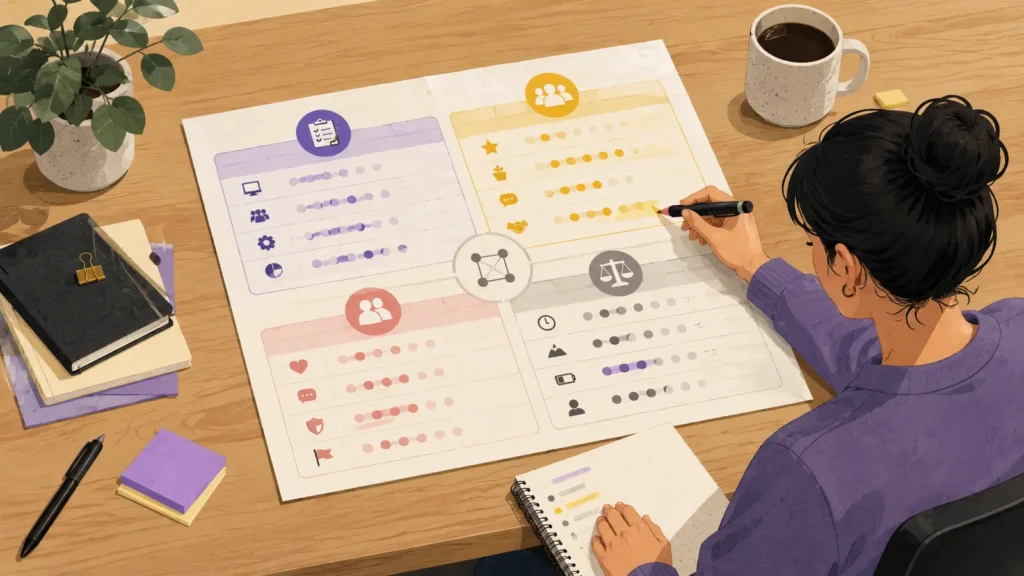
    Eight work environment dimensions including teamwork, focus, pace, autonomy and location
    Compare specific work conditions instead of relying on a vague idea of company culture.

    How to complete the checklist without guessing

    1. Collect evidence from contrasting situations

    Choose at least three experiences that felt different: perhaps a quiet individual assignment, a busy group event and a tightly scheduled shift. For each one, note the conditions, your energy before and after, the quality of your work and what you wanted to change. Repeated patterns deserve more weight than one difficult day.

    2. Separate needs, preferences and bonuses

    Label each answer need, prefer or bonus. A need protects health, responsibilities or reliable performance. A preference makes work more enjoyable but allows compromise. A bonus is welcome but should not eliminate an otherwise strong option. Limit yourself to three needs so the checklist remains usable.

    3. Translate vague words into observable conditions

    Replace “flexible,” “friendly” or “fast-paced” with something you could verify. Flexible might mean choosing start times, working remotely twice a week or deciding how to complete tasks. Friendly might mean respectful feedback and colleagues who share information. Specific language produces better questions for employers and professionals.

    4. Research occupations and employers separately

    An occupation profile can show typical conditions, but an employer controls schedules, supervision, staffing and location policies. Read several current job descriptions, use O*NET to compare work context, and ask people in the role what an ordinary week looks like. Then check the organisation’s practices instead of relying only on its stated values.

    Useful research question: “During a normal week, how much time is spent working alone, in meetings, with customers and responding to urgent requests?” Concrete percentages reveal more than asking whether a workplace is collaborative or busy.

    A realistic example: comparing two promising paths

    Aisha is considering data analysis and client insights. Both use her interest in evidence, but her first checklist is contradictory: she says she wants teamwork, quiet focus, variety and a predictable schedule. She reviews past experience and becomes more precise. She needs two uninterrupted focus blocks most days and predictable evenings. She prefers a small team and varied projects, but she does not need constant conversation.

    Research shows that either path could fit, depending on the employer. A reporting-heavy analyst role offers focus and stable cycles but may feel repetitive. A client-insights role offers variety and collaboration but can bring frequent meetings and deadline spikes. Aisha does not reject either title. She asks about meeting load, deadline patterns and task ownership, then completes a short research project with a team. The experience gives her better evidence than the title alone.

    Young adult testing quiet, collaborative and active work environments before choosing a career
    Small experiments turn workplace preferences into evidence you can use.

    Test the environment before committing

    A checklist becomes valuable when it changes what you investigate. Choose one low-cost test that exposes the condition you are uncertain about:

    • Ask a professional for a 20-minute informational interview focused on daily conditions rather than career advice.
    • Visit, shadow or tour a workplace and notice noise, interruptions, physical demands and how people communicate.
    • Complete a short project under realistic deadlines, with either independent ownership or team coordination.
    • Review several vacancies from different employers and compare schedules, travel, supervision and customer contact.

    After the test, rate each dimension from 1 to 5 for fit and confidence. A low fit with high confidence is a genuine warning. A low-confidence score means you need more evidence, not an immediate rejection.

    Reassessment rule: Review your checklist after a new internship, job, major life change or six months of repeated discomfort. Preferences can develop with skills and circumstances, so treat the document as a working hypothesis—not a permanent identity.

    Use environment fit as one part of career planning

    Work environment should narrow and improve your options, not decide everything alone. Combine it with interests, strengths, values, entry requirements and financial realities. Start with how to use work values in career choice, clarify priorities with examples of work values, and examine scheduling evidence in evaluating work-life balance before choosing a career.

    Frequently asked questions

    What is a preferred work environment checklist?

    It is the combination of social, physical and organisational conditions that helps you work effectively and sustainably. It includes more than office versus remote work: pace, autonomy, interaction, structure, sensory demands, variety and time boundaries all matter.

    Should every item on my checklist be non-negotiable?

    No. Too many non-negotiables can hide workable options. Protect genuine needs, identify preferences and keep bonuses optional. Three well-supported needs are usually more actionable than a long wish list.

    Can the same career offer different work environments?

    Yes. The same occupation may operate differently across industries, organisations, team sizes and managers. Research both the occupation and the specific employer before deciding that a title fits or does not fit.

    What if I have very little work experience?

    Use evidence from school, volunteering, clubs, sports, family responsibilities and personal projects. Then run small experiments. You do not need a full-time job to learn whether you prefer quiet concentration, frequent teamwork, fixed routines or changing priorities.

    Turn your preferences into clearer career directions. Take the RoleQuiz Study & Career Assessment, then use your results alongside this preferred work environment checklist to research and test suitable environments.

  • What Work Environment Suits Your Personality? A Practical Guide

    What Work Environment Suits Your Personality? A Practical Guide

    Direct answer: If you are asking, “what work environment suits my personality?”, compare the conditions in which you consistently do your best—not a personality label. Rate your preferred pace, amount of structure, level of interaction, degree of autonomy and sensory load. Then test those preferences against real workplaces. The right environment is usually a combination, such as calm but collaborative, structured but self-directed, or fast-paced with clear priorities.

    A job title does not reveal the whole working experience. The same occupation can feel completely different in a quiet research team, a busy agency, a highly regulated organisation or a remote start-up. That is why career fit depends on both what you do and the conditions surrounding the work.

    Why personality-to-environment matching is difficult

    People often reduce work environment to “office or remote” or “introvert or extrovert.” Real fit is more detailed. You may enjoy people but dislike constant interruption. You may prefer freedom but still want clear deadlines. You may like variety when the purpose is stable, yet feel drained when priorities change without warning.

    Your preferences can also change with skill, health, responsibilities and life stage. A student may think they dislike teamwork after experiencing one poorly organised group project. An early-career employee may want more guidance now and more independence later. Treat your profile as a current hypothesis, not a permanent identity.

    Key principle: Do not ask which environment matches your “type.” Ask which observable conditions help you concentrate, communicate, recover and produce good work repeatedly.

    What work environment suits my personality? Compare five dimensions

    Use the five dimensions below to describe your ideal working conditions. Avoid choosing an extreme simply because it sounds impressive. Most people need a range, and the best range can vary by task.

    1. Pace: steady or fast-changing?

    Steady pace usually means predictable workloads, longer planning horizons and fewer urgent switches. Fast-changing pace brings quick decisions, frequent deadlines and rapid feedback. Think about your performance after several weeks, not the excitement of one busy day. Do you become sharper under time pressure, or does repeated urgency reduce your accuracy and energy?

    2. Structure: defined or flexible?

    A defined environment provides standard procedures, clear responsibilities and established quality checks. A flexible environment gives you room to design the method as you go. Structure is not the same as micromanagement, and flexibility is not the same as disorder. You might want a clear outcome with freedom over how to reach it.

    3. Interaction: frequent or focused?

    Some roles involve near-continuous conversation, negotiation or coordination. Others concentrate interaction into planned meetings and leave long periods for independent work. Ask how much social contact you can sustain while still thinking clearly. Also separate meaningful collaboration from random interruption; you may enjoy the first and dislike the second.

    4. Autonomy: guided or self-directed?

    Guided work includes closer supervision, faster feedback and more shared decisions. Self-directed work gives you control over priorities and execution, but also requires comfort with ambiguity and accountability. Your preferred level may depend on experience. Wanting guidance while learning is not evidence that you lack initiative.

    5. Sensory conditions: calm or stimulating?

    Noise, lighting, movement, crowding, temperature, travel and physical activity all shape the workday. Some people feel alert in a lively environment; others lose focus. Consider whether you need a quiet room, headphones, natural light, physical movement, outdoor time or regular changes of setting. These practical details can matter as much as company culture.

    Evidence check: O*NET separates work styles—personality tendencies expressed at work—from work context, the physical and social conditions of an occupation. Use both when researching a career.

    Complete the work-environment preference profiler

    Work environment preference profiler for pace structure interaction autonomy and sensory load
    Compare five work-environment dimensions instead of relying on a personality stereotype.

    Rate each dimension from 1 to 5 using evidence from classes, projects, part-time work, volunteering or hobbies. Write one example beside every score. A number without evidence can easily reflect the workplace you think you should prefer.

    Dimension135Your evidence
    PaceSteadyMixedRapidWhen did you perform best?
    StructureClearly definedBalancedHighly flexibleHow much direction helped?
    InteractionMostly focused solo workPlanned collaborationFrequent contactWhat level was sustainable?
    AutonomyClosely guidedShared decisionsSelf-directedHow did you handle ambiguity?
    Sensory loadCalmModerateHighly stimulatingWhat affected concentration?
    Score preferences as ranges, then support each one with a real example.

    Circle your two strongest needs and one flexible preference. For example, you might need low sensory load and planned interaction, while being comfortable with either a steady or moderately fast pace. This prevents you from searching for an impossible “perfect” workplace.

    Turn your profile into career-research questions

    A preference becomes useful only when it helps you investigate real opportunities. Translate each score into a question you can ask during research, an informational interview, a workplace visit or a job interview.

    • Pace: “How often do priorities change within a normal week?”
    • Structure: “Which tasks follow established processes, and which require creating a new approach?”
    • Interaction: “How much of the day is spent in meetings, client contact or independent work?”
    • Autonomy: “How are decisions divided between the employee, manager and team?”
    • Sensory conditions: “Where is the work performed, and what are the typical noise, movement and travel levels?”

    Job advertisements may use phrases such as “dynamic,” “collaborative” or “self-starter,” but those words are vague. Ask for examples. “Dynamic” could mean interesting variety or constant emergencies. “Collaborative” could mean thoughtful peer review or an uninterrupted calendar of meetings.

    A realistic example: Maya compares two marketing roles

    Maya is a graduate who enjoys analysing customer behaviour and presenting ideas. She assumes a creative agency must suit her personality. Her profiler shows a different picture: pace 3, structure 4, interaction 3, autonomy 4 and sensory load 2. She likes variety, but not daily urgency; collaboration, but not constant conversation; independence, but with a clear objective.

    She speaks with people in two roles. A small agency offers rapid client changes, an open-plan office and frequent team sessions. An in-house research role offers planned project cycles, quieter focus time and independent analysis with weekly collaboration. Both use similar skills, yet the second environment better matches her strongest conditions.

    The useful conclusion is not “Maya is an introvert.” It is: “Maya works best with focused analysis, planned collaboration, clear priorities and control over execution.” That statement is specific enough to test.

    Student observing a real work environment before choosing a career
    A workplace visit can reveal pace, interaction and sensory conditions that a job title cannot.

    Test a work environment before committing

    Do not rely only on imagination or one assessment result. Observe the environment directly whenever possible. Shadow a professional, complete a short project, volunteer, visit a workplace or ask for a detailed description of an ordinary Tuesday. Notice interruptions, decision speed, feedback style, workspace conditions and how people recover after intense periods.

    1. Record what energised you and what drained you.
    2. Separate unfamiliarity from genuine mismatch; new tasks often feel tiring at first.
    3. Compare two settings within the same field so you do not confuse an occupation with one employer.
    4. Repeat the test on more than one day or project before making a major decision.

    You can strengthen this process by reviewing how to choose a career based on your strengths, comparing career interests versus skills, and learning how to find careers that match your curiosity. Together, these help you judge tasks, capabilities and conditions rather than treating personality as destiny.

    Choose the next action and set a review date

    Select two environments worth testing. For each, choose one low-risk action you can complete within the next two weeks: an informational interview, workplace visit, project simulation or conversation with a course adviser. Write down what evidence would change your mind.

    Review your profiler after the experiments. Keep preferences supported by repeated evidence, soften assumptions based on one bad experience and note any trade-offs you can accept. A suitable environment does not remove every challenge; it makes the normal demands sustainable enough for you to learn and contribute.

    Explore your personality and career-fit patterns. RoleQuiz can help you organise clues across personality, interests and strengths. Use the result to generate questions, then confirm those ideas with real workplace evidence. Start the RoleQuiz career orientation assessment →

    Frequently asked questions

    Can one personality test tell me my ideal work environment?

    No single result should make the decision for you. A well-designed assessment can suggest patterns and useful questions, but your history, current needs and direct experience provide essential evidence. Treat the result as a hypothesis to test.

    Does being introverted mean I should work alone?

    Not necessarily. Introversion does not reveal whether you enjoy collaboration, mentoring, client work or public speaking. You may prefer meaningful interaction in smaller doses, scheduled meetings or quiet recovery time between conversations.

    Is remote work always better for people who prefer quiet environments?

    No. Remote work can reduce office noise but add isolation, household distractions and communication ambiguity. A private office, hybrid schedule or quiet on-site team may fit better. Compare actual conditions instead of relying on the location label.

    What if no workplace matches all my preferences?

    Prioritise two non-negotiable conditions, identify one or two flexible preferences and compare the trade-offs. You may also be able to improve fit through role design, schedule changes, workspace adjustments or clearer communication with a manager.

    Final thought: describe conditions, not stereotypes

    When you ask “what work environment suits my personality?”, look beyond a type name. Describe the pace, structure, interaction, autonomy and sensory conditions that support your best work. Then test that profile in the real world. A specific, evidence-based answer will guide better career decisions than a flattering label ever could.